-
Liberalism is Leftism
By Manuel de la Cruz, translation by Alberto R Zambrano U
From the perspective of political sciences, the left encompasses every movement that advocates for horizontal societal configurations. Be that as it may, it can be equality by means of liberal judicial polity, or by socialist economic equality.
Jacobins, liberals —and in some fashions, anarchists— were the first European leftist movements. The socialist weltanschaaung is the direct heir of liberalism and its first authors vindicated the liberal leitmotif of a society of free and equal men, coupled with the introduction of economic reforms that assured equality in real terms. And by real terms, they meant the economy sphere.
The original socialist, far from entering in the contradictions of liberal categories, was always a political scientist with the capacity of materializing freedom amongst its peers. Moreover, that thought led him to believe that freedom was relative, atomized and in accordance to a general consensus that “either everybody is free equally, or nobody is”. And that train of thought derived in Marxist radicalization and the post-Marxist train of thought of those liberals who decided to embrace the commune.
It’s important to note that liberal freedom, or modern freedom, contradicts the freedom of the classic form.
In the classic era, a society was free when every one of its components could configure an order to submit, to reach public happiness. The non-domination of a foreign goverment made the Polis free: that created the incentives for the citizens to go to arms every time a foreign empire decided to enslave them. That dichotomy of freeman-slave was quaintly defined and yet it did the work in a remarkable manner.
The classic freedom, public freedom, doesn’t consider men equal amongst themselves. That’s why the roles they assume in the political order, and their capacities would give them different tasks and different entitlements. That’s why we must talk about private legislation, privileges, and designations of unequal degrees of liberty.
Feudal nobility, for example, gives hereditary rights to merits and services to a family for a kingdom or realm. The marquis, responsible for a border of strategic importance had all the privileges for his title. Noblesse obliges.
For liberals, who consider all men to be equal, liberty must be enjoyed in equal terms. Nobody should have less liberties than the one next to him. But contradictorily, seeking to abolish that hierarchical distinction of the degrees of freedom, they abolish and replace freedom as a noun, by the discourse of “liberties”: those are prerogatives that we have just by being human.
So, the diaphanous distinction between being free or being a slave, is being diluted in legal trivialities of inferior precept such as freedom of thought, freedom of expression, freedom of the press, freedom of movement, freedom to marry with people of the same sex, the freedom to think that sex is a social construction, the freedom to have an abortion… and so on, until displacing with a mare magnum of freedoms, demands and guarantees the fundamental fact of freedom: free is only he who does not he is a slave.
It is logical that the liberal classrooms formed castes of politicians who, faced with the biological impossibility of being absolutely free, would settle for the prerogative of at least achieving equality, even in slavery.
Therefore, the State went from being an enemy to be abolished, to being a necessary evil and an instrument for egalitarian leveling. Socialists, in a sense, are still quite liberal. They intend to strip us of inequalities through a transitory slave economic order that, after the demolition of the traditional structures of religion, family, country and property, obtain a new man sufficiently homogenized to be able to enjoy full freedom.
Of course, a contemporary liberal would deny such an ideological genealogy, perhaps hiding behind novel categories such as libertarianism. And even his socialist opponents, those who find liberal freedom insufficient, would be outraged.
Both are, after all, heirs to the main Jacobin and bourgeois revolutions that hit Europe after the advent of rationalism. More than economic, their mutual ancestry is of a theological order: they are the prophets of the Goddess reason, and their fight against traditional superstition.
It is these rational gentlemen, organized in lodges, who by proclaiming themselves lovers of the human race have done the most damage to it in the world of ideas. In the words of Laureano Vallenilla Lanz «The worshipers of the goddess Reason have been the least reasonable men in the entire world; the friends of the people have been the ones who have shed their blood most abundantly and have dragged it into crime and misery».
-
Venezuela’s fall: from soursop to watermelon
By Alberto Zambrano
The role of the Christian Democrats during the so-called Civil Republic period of 1961-1998 paved the way for today’s current political deception, the “right-wing conservatism of Christian democracy” is undoubtedly a subject for every right-winger in Venezuela to consider if they want to play politics.
At Cultura Política & Uniendo Puntos, we have left our impressions on the current state of “democracy,” and we have written extensively on the problems of liberal democracy.
We consider that it is essential for English spoken readers to get the alternative perspective to the official narratives on the aspects of Christian Democracy that profoundly influenced chavismo and shaped the way of the current dynamics of politics in Venezuela.
Origins of COPEI
The Independent Committee of Political Electoral Organization, the Social Christians, the Green Party, has its roots in the National Action Party and the Falange-inspired National Student Union formed by Roman Catholic students from the cold Andean Venezuelan states of Táchira, Mérida, and Trujillo during the 1940s: Among them Rafael Caldera, Ravard, Rodríguez Uzcanga, and Lara Peña.
The National Student Union was a breakaway organization to the Venezuelan Student’s Federation after the latter chose to ban all religious organizations from public life, including the Society of Jesus, bankrollers, and teachers of the founders of the National Action Party. Inspired by the Spanish Falange, young members of the National Student Union saw in the clique of hoodlums of the Communist Party a threat, and for the Communists worldwide, the Falangist movements were natural enemies of the Proletarian Cause, dating back to the Stalinist Meddling in left-wing Spanish Republican politics.
The conduction of politics in 1940s Venezuela was one full of fiery speeches in the rostrums and heavy-hitting with the truncheons in the streets: COPEI is famous for beating up Leoncio Martínez (1), and AD was famous for killing their own, namely: Leonardo Ruiz Pineda. (2) After the overthrow of Isaías Medina Angarita, the Revolutionary Junta appoints Rafael Caldera as Solicitor General, the harsh communist rhetoric of Acción Democrática drew strong opposition from the average citizens, who saw communism as a strange doctrine from the cold lands of Piano composers. The press also drove that sentiment.
Back in the ’40s, the press was regularly summoned to Miraflores Presidential Palace to receive lessons on editorial policy, to which they quietly acquiesced: Miguel Otero Silva’s El Nacional and Miguel Angel Capriles’ network are prime examples of this (3).
At the time, every Venezuelan political organization that wished to have some relevance had to resort to mass gatherings & demonstrations — Bread & games.
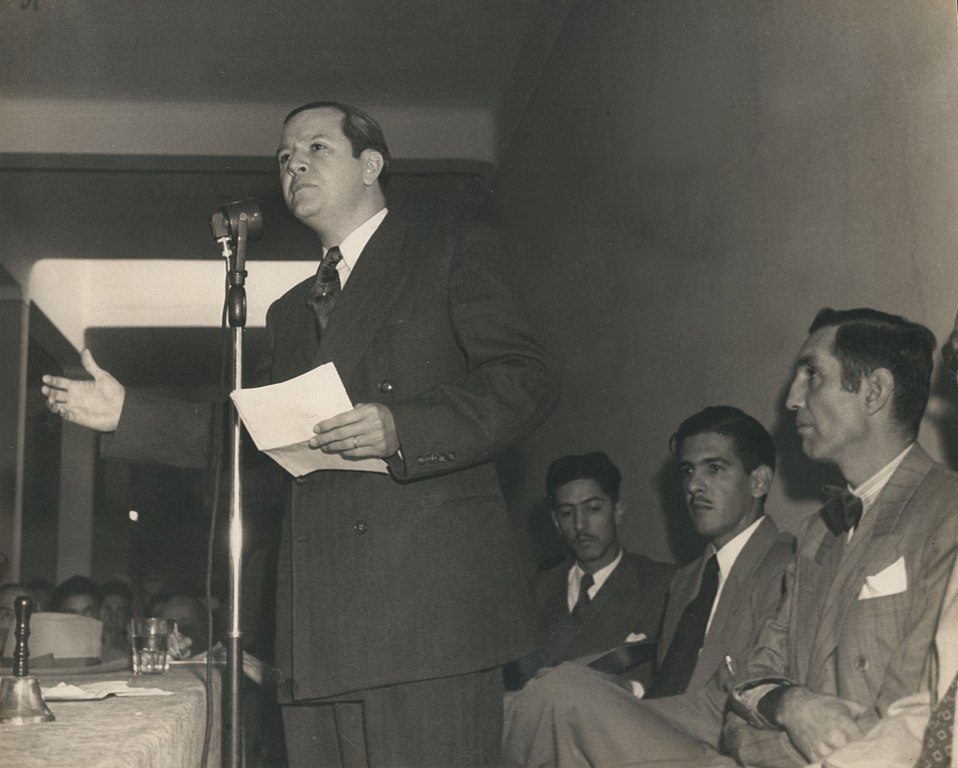
The Caracas’ Nuevo Circo bull-fighting ring was the venue chosen by Rafael Caldera in which he decided to make public his resignation to the Solicitor General Office and draw attention to his political party. That event was the first major Christian Democrat gathering in Venezuela’s political history.
During Perez Jimenez’s government, COPEI cooperated with the state policy of stifling insurgency while conspiring with low-rank officers that were in cahoots with the communists. Top-level intelligence officer Pedro Estrada explained to Agustín Blanco Muñoz in 1983 that COPEI’s role in the Perez Jiménez government had been one of a controlled opposition because Venezuela’s Directorate of Homeland Security had informants reporting every vital movement.
COPEI’s leader Rafael Caldera went at odds with the Perez Jimenez administration after an alleged botched bombing and took refuge in the Apostolic Nunciature of Caracas then fled to New York, where Caldera nurtured himself with the intellectual baggage that allowed him to produce written work for posterity.
Nevertheless, it was Rafael Caldera’s way of conducting politics in a personal style that made an imprint in the Christian democrats of using a doctrine axis as a means to reach, exercise and further deepen the grip upon political power, to push for change and affirm political participation as a motor for social reforms.
The combination of the Christian democrat doctrine led by Caldera, as well as the use of infiltration & tightly-knit intelligence networks, were the elements around which chavismo got inspired to execute its exercise of power.
The Adeco way of dealing with the Military
The origins of Venezuela’s Military Academy date back to when General Juan Vicente Gómez felt the need to modernize the army and imported Chilean colonel, Samuel McGill, to run the academy under a Prussian model. Before the military academy institution, officers in Venezuelan armed forces were illiterate cowboy riders & cattle rustlers within Gomez’s clique.
The concept of “seniority” measured in time of service or merit is a respected military tradition. Venezuela’s historical political unrest made it almost impossible to maintain seniority, one of the pillars of the military institution.
After Marcos Pérez Jiménez ‘s forceful removal from office, adecos reincorporated expelled officers, several communists amongst them with contacts with USSR representative to Venezuela Gustavo Machado.
Acción Democrática’s leadership saw the threat of communist infiltration in the armed forces, namely in the way that Rear-Admiral Carlos Larrazábal was buddies with a top USSR spy. The Rear-Admiral had a knack for being on everybody’s side, being good friends with Perez Jimenez cost him the Ministry of Defense in favor of an Air Force general by the name of Jesús María Castro León, who claimed to be as senior as Rear-Admiral Wolfgang Larrázabal (Carlos’ brother) despite losing four years of service after a dishonourable discharge for plotting against Juan Vicente Gómez.
In 1935, right after Gómez died, Castro León rejoined the armed forces, only to be kicked out again in 1958 for threatening Wolfgang Larrazábal. This revolving door at the Ministry of Defense led to Castro León staging an uprising in Táchira on April 20, 1960 (4) with the help of Dominican Republic’s Rafael Leónidas Trujillo (5) with intentions of setting up another Pérez Jiménez-like regime but with ideological notes of left-of-center Gamal Abdel Nasser with conflated critical theory of the historical manipulation of Simón Bolivar’s life, aiding him with the plot were the Hernández Carabaño brothers and double agent Carlos Savelli Maldonado (6).
Getting rid of Marcos Perez Jimenez’s supporters in the Armed Forces implied for adecos that the policy of seniority had to be tweaked.
The average graduation of Second Lieutenants at the time, by the time a general reached age 50 that meant automatic retirement. When Betancourt suffered a botched assassination attempt plotted by Trujillo (7), a car bomb that exploded killing a man and wounding Minister of Defense General Josué Lopéz Hernández.
Rómulo Betancourt had to replace López Hernández and chose General Antonio Briceño Linares over senior officer Rear-Adm. Larrazábal(8).
So right after General Castro León’s adventure, Betancourt wanted to get rid of the remaining colonels loyal to Marcos Pérez Jiménez.
The Betancourt Administration passed an act that retired Armed Forces officers after thirty years of service.
The law signed by Betancourt was supposed to last ten years, and in practice, it helped created an Acción Democrática-friendly ring of influence in the Armed Forces. The decree allowed Betancourt to extend the service time of any officer he wanted, This allowed Gen. Antonio Briceño Linares and then General Ramón Florencio Gómez to serve Betancourt & Leoni and effectively to stifle the Soviet plan of placing a red proxy in the Ministry of Defense. The political ring of influence served to secure national defenses from tyrants of the Fidel Castro and Rafael Leónidas Trujillo variety; it also paved the way for the creation of political cronyism within the armed forces.
A seed for the fruits that COPEI’s best would later sow in cahoots with the worst class of politicians that Acción Democrática would train- as pundit Daniel Lara Farías likes to say in his radio shows.
It is essential to state that Generals Briceño Linares and Gómez had a pivotal role helping fight communist subversion led by Fidel Castro, for their tenures saw the Barcelonazo, Carupanazo & Porteñazo revolts as well as the Machurucuto Beachfront Incident, Fidel’s own Bay of Pigs.
COPEI’s First Electoral Victory: “It was necessary.”
The Venezuelan 1968 Presidential Election was a close call in which adeco candidate Gonzalo Barrios was tricked out of the election by his party to let COPEI’s Rafael Caldera win in hopes of showing foreign investors that the new Venezuelan democracy was stable, that Venezuela was a safe bet, backed by the American administration seal of approval.
Tricking Gonzalo Barrios infuriated the Acción Democrática party base, and the military had to watch in complacency as the Supreme Electoral Council, Venezuela’s electoral authority discarded the votes and called the election in favor of Caldera, a marginal 30.000 votes, created through trickery, fraud, and deception.
In a conversation I had with Simón Alberto Consalvi regarding democratic change somewhere in 2010, the 1968 Venezuelan election was brought up: “It was not a transparent victory, Caldera’s first presidential victory was fraudulent, we [the adecos] gave Caldera the election, it was necessary.” Carlos Andrés Pérez would say to Giusti & Hernández that massive electoral fraud in Barinas (homeland of Hugo Chavez) & Lara states was evident.
However, it was convenient for the birthing democracy to show that by using rigged elections, the political elite could stage a regime change under the complacent eye of the military, which is kept at bay with contracts and juicy pension funds.
The Green Way of dealing with the military
If the Adecos seeded the ground for political cronyism within the armed forces, Caldera doubled down on courting the Armed Forces with excessive military promotions and contracts. His first controversial episode was when he had to name his Minister of Defense.
The Acción Democrática-friendly military was expecting that Caldera would pick an officer according to the seniority tradition. However, Caldera felt the need to cement his place amongst the ranks of the political elite by giving power to the military that had either strong opposition to AD or staunch COPEI supporters.
The Senate Commission in charge of promoting the military halted Caldera’s policy of giving money and guns to anyone that would oppose AD with an Armed Forces uniform.
Caldera’s pompous pretensions of a highbrow Bolivarian Prussian-inspired army of social-Christian intellectuals was just a blown-up fantasy concocted by him and his supporters. The 1960s were rife of communist subversion in the Americas, led by the Bearded Cuban Marxist guerrillas. Fidel Castro always saw in Venezuela the beachfront for his domination of the American Continent, so when courting the social democrat adecos failed, Fidel turned to guerrilla leader Douglas Bravo to construct a plan to infiltrate the Armed Forces, these officers were benefited with Caldera’s policy of promotions.
Caldera’s first pick for a defense minister was not an officer based on seniority like General Pablo Antonio Flores Alvarez, a man whose role in the military recognizing Caldera’s victory was pivotal, but a general of his choice using his presidential prerogative.
The massive fraud which robbed Gonzalo Barrios out the 1968 presidential election, coupled with his reluctance to become president under a pyrrhic victory infuriated the military spirit of the Prussian-inspired, Chilean-imported Military Academy doctrine of Samuel McGill, whose disciples took inspiration from Gamal Abdel Nasser, Mustafa Kemal Atatürk & Simón Bolívar’s body of work to conflate a theory of nationalism under the civic tutelage of none other than from men grown from the rank & file of the Communist Party of Venezuela that created a breakaway political party to claim power. General Pablo Flores had both the seniority and the merits of defending Venezuela’s unstable democracy against communist subversion, namely stifling Castro León’s coup.
As we can see, the way in which Rafael Caldera mimicked his rivals’ military relations set up a time bomb for Venezuela’s stable democracy that would see its frail veil of stability finally crushed by Hugo Rafael Chávez Frías in 1992.
Bibliography
- (1) Hernández, Ramón, and Roberto Giusti. Carlos Andrés Pérez: Memorias Proscritas. First ed., Caracas, Libros El Nacional, Editorial CEC, Jan. 2007, p. 50. Chapter 10: Victims of Medinismo gives a political context of Venezuela in the 1945 Revolutionary Government.
- (2) Blanco Muñoz, Agustín. Pedro Estrada Habló. First ed., Caracas, Consejo de Desarrollo Científico y Humanístico UCV, July 1983, p. 167
- (3) (1) Ibid, p.49
- (4) Barragán, L. (2004, April 20). A 44 años de la invasión de Castro León. Retrieved from https://www.analitica.com/opinion/opinion-nacional/a-44-anos-de-la-invasion-de-castro-leon/. Archived at http://archive.is/LlISS
- (5) (1) Ibid, p.121. Chapter 30: Castro León uprises in Táchira
- (6) Suniaga, F. (2018, August 7). El atentado a Rómulo Betancourt. Retrieved from https://prodavinci.com/el-atentado-a-romulo-betancourt/. Archived at http://archive.is/kOe0h
- (7) Díaz Espejo, A. (2009, June 23). CRÓNICA “La necesidad crea el método”. Retrieved from https://antoniodiazespejo.wordpress.com/2009/06/23/la-necesidad-crea-el-metodo/. Archived at http://archive.is/HjVVp
- (8) Peñaloza Carlos. (2014). Chávez, el delfin de Fidel: la historia secreta del golpe del 4 de febrero (1st ed.). Miami: Alexandria Library. p 102
Editor’s Note:
This report was originally posted at my Patreon page.
With your support on Patreon, I can afford to produce better content, such as software licenses, hosting, research & stock photography. With your subscription you get perks & exclusive material.
Yours truly, Alberto Z. -
José Luis Santamaria Speaks: “It’s nice to be back”

By Alberto Zambrano
Thursday morning begins with a series of cloak-and-dagger maneuvers, we look over our shoulders the entire time, —because like the Iron Maiden song “we’re sure there’s someone watching”, still there’s no fear of the dark— the break of dawn in the Valley of Caracas is always a beautiful sight, especially when the cold morning weather and the first rays of light shine up such a troubled city, Caracas is no longer the metropolis it once was.
It sure was different for him, when he was put behind bars people could shake hands, hug and cheer each other, maybe light up a cigarette, now it all changed, even for him as he moves on. Always on time, khaki pants, leather loafers, long-sleeve buttoned-up shirt, he sports a satchel where he carries his belongings.
Our dialogue begins as it began the first time: A simple “Good Morning, buddy.” That’s how José Luis Santamaría begins his day, every day. His dark hair, big eyes, carefully trimmed goatee, and fair complexion complement his coarse voice, and resolute drive to live.
Recently released from a military prison for committing the heinous crime of giving Oscar Perez a final good-bye at a graveyard, the nationalist activist shakes hands, visibly thinner, but with the same spirit before his incarceration: he smiles. There’s something about the smile of this man that makes you wonder how can he keep up that spirit after what he’s been through. “I’ve been living every day as it were my last, I’m free, I’m happy.”
Powerful words coming from a man who was unfairly detained, tortured in the most horrible ways, and submitted to an arbitrary judicial process where he had no chance to defend himself.
The worst thing that can happen to a political detainee is that nobody will remember him or her. That quote comes from a political prisoner that did much more time than Jose Luis, trigger-happy police commissioner Ivan Simonovis barely saw 33 days of sunlight in more than a decade, causing him a vitamin deficiency that made his bones brittle.
Simonovis’ judicial process, widely written, commented, and taken to international courts has a darker side. Jailed with Simonovis were a group of other police officers whose trigger-happy antics during the April 11 events sent them to the same military prison where Jose Luis was thrown in.
These police officers remain in custody and in a Nietzschean twist of events —where the abyss gazed back at them—these police officers became prison ringleaders and thus became the jailers of Jose Luis, who submitted him to starvation, beating him up constantly, taunting him for his faith, they took from him his rosary praying beads and his bible, they took his food and water, they made him urinate and defecate in a plastic bag for days.
These sorts of cruel and unusual punishments would trigger anyone a very nasty case of post-traumatic stress disorder. Not for José Luis. This man is happy he’s out there because he knew his friends wouldn’t forget about him: “I knew you guys wouldn’t forget about me. Now that I’m here, free, so far away from that place, I look at my life and I wouldn’t change a goddamn thing.” He repeated himself every day the same thing: “People out there know my story.”
Shortly after his release, he took some time to reorganize his life, then he went back to his activism. “I want people to know my story, I believe it’s a hell of a story, not everyone can put up what I had to go through.” We ask him about revenge: “I don’t have time for that, those guys will pay what they did to me sooner or later, for me, it’s all about enjoying life now, I can’t recover that time they made me lose there, but I’m going to live every day as it were my last”.
Jose Luis has always been restless, he looks around and we take a stroll. “D’ya think intelligence follows us? They always are, it’s a police state”, he points at a CCTV and we continue our talk. Unlike other Cultura Política pieces, that focus on intelligence, today’s piece aims to point out the resolute attitude of a man who saw the worst of adversity and smiles back. “I can forget, I won’t forgive, and boy, do I have a lot to do.”
Jose Luis’ family fled the country and represented him abroad, he’s on his own, trying to redo his life, his identity was nearly erased, the telecoms technician scrambles around town seeking to recover an ID card from the people that put him in jail, a bank account at closed banks, even a telephone line. If it were possible for him, Jose Luis would tour the country and organize meetings to raise awareness.
Coronavirus isn’t stopping him, he plans ahead and looks to the horizon. We see how the sunlight shines upon his face, the fresh air from the Avila mountains touch us and he closes his eyes and takes a deep breath, he smiles and says “It’s good to be back. I missed the fresh air.”
Don’t make Jose Luis angry, his smile quickly fades away and his eyebrows tighten and the thunderous sound of his voice resounds. What makes this man angry after the kinds of things he’s been through? “The other day I asked for a coffee and got a tasteless cup of dark water.” This is a man who enjoys the simple things of life, he loves nature, he learned to survive, and he knows how to use technology.
Anger isn’t typical to his character, he’s a devout catholic man who only cares about his business, wants to exercise his faith “I miss church. They’re closed now”, and wants to see his country in freedom from the chains of the communist tyranny that Chavismo represents.
When asked about how it was there, here we have a man who has no problem telling us the harrowing tales he’s been through. However, he wants to let everybody know that the past is the past, and people should focus on what’s ahead.
As we end our chat, he thanks us, his voice breaks a little and the emotion is in his face as he takes another breath of fresh freedom air. “Thank you, you’ve made my day, I wish you all the best. Remember our country’s motto: ‘God and Federation’. Talk to you soon, God bless you and take care.” These are the words of a man who’s been to hell and back and whose story is worthy of publication in the shape of a novel or a Netflix film. Life goes on.
-
Venezuela’s Communists Squandered Millions of Dollars in Soviet Aid

By Alberto Zambrano
This article is part of an investigation work that covers nearly sixty years’ worth of history. For months, the editorial team at Cultura Política English burnt eyelashes and spent a significant amount of time digging in open-source intelligence sources trying to connect the dots of the sordid, peculiar, and utterly criminal network of hoodlums that had a common sign: a Red Rooster in a red background with a hammer & sickle juxtaposed in them. With information taken from the written and published work of Ariel Gryner, of talks with history professor Agustín Blanco Muñoz, conversations along the years with several influential military leaders and politicians, we expand the initial feel of this text, found entirely in a Venezuelan magazine called “Exceso.”
Without further ado, we shall explain that the communist insurgency of Venezuela had Soviet sugar daddy financiers, their protagonists –now in the dusk of their lives after cozying up with the status quo– blatantly deny it. The socialist insurgency was supposed to be all about romanticism and hard work; in reality, it was mere larceny, cocktails, drugs, whoring, violence & embezzlement of the most rancid Caviar Leftism.
Origins of Venezuelan Communism
Arising from the ideas of Karl Marx in 1864, the International Workers Association was born. The First Socialist International lasted until 1872, thanks to the disagreements between the followers of Marx & Engels and those more akin to the views of Mikhail Bakunin that saw in the Paris Commune insurrection of 1871 the materialization of their ideals. The anarchists and communists never agreed in the practical sense and trashed the project. Even so, the ghost of Communism was –and is– still alive.
A Parisian congress held in 1889 creates the Second International, and the division between Bolsheviks & Mensheviks and the revisionist tendencies of the German Communist Party is present with Eduard Bernstein & Karl Kautsky on one side. With Rose Luxembourg and Karl Liebknecht on the other, both rose in arms and saw their deaths in 1919. When Vladimir Lenin, holding reserves about the efficiency of the organization, takes it upon himself to kickstart the Third International –the Komintern– with the sole goal of shunning reactionary socialist behaviors.
Lenin dies a victim of his impulses and excesses –syphilitic dementia– but his spirit and ghost continue to scare everybody in the world. The so-called father of the peoples of the world ended up a mummy, and Joseph Stalin, “the clean sword of Man” –as the Venezuelan author Carlos Augusto León dubbed him– starts to rule the Soviet Union from 1927 to 1953, the most glorious and gloomy times of Soviet history. Massive collectivization, gargantuan industrialization, and the simple exercise of power. Until his death, Stalin dreamt in the marble-lined floors of the Kremlin with the Soviet Union reaching as far and wide as possible.
In 1947, the Kominform was founded. It was the Office of Communist Information that unsuccessfully tried to control the Chinese Communist warfare and Mao’s triumphant entry into Beijing in 1949. The Third International faded –at unison with the end of the Second European Civil War– but Communism was still alive.

From left to right: Jesús Faria, Max García, Manuel Taborda, Millán & Pedro Ortega Díaz —communist lobbyists at the Venezuelan Ministry of Labor
Then came Nikita Kruschev with his expansionist policies –he uses the power of the “Peaceful Atom” to strong-arm the West in the Suez Canal Crisis. He builds a wall and puts the western hemisphere in check with the Cuban Missile affair.
Leonid Brezhnev reinstated Stalinist practices, and at his time, the red spark began in Venezuela. Communism was deemed a weird ideology in the land of Marcos Pérez Jiménez & Simón Bolivar, and it wasn’t considered a threat until the 1960s.
“Lead & Silver” were considered the ingredients of the national revolution according to communist mouthpiece Eduardo Machado –a concept further developed by another ally of the Left, Pablo Escobar, in the form of “Silver or Lead” –. During the times of the Third International, Soviet Revolutionary Imperialism penetrated Venezuelan politics in the way of “Red Aid.” The organization provided administrative, educational, military, and economic assistance to weak parties or those deemed illegal. The Venezuelan recipients of Red Aid are either dead or currently in the Chavista government or conveniently infiltrating the opposition.
Communist bulwarks like Teodoro Petkoff & Pompeyo Marquez conveniently denied Soviet infiltration of the Communist movement in Venezuela, while Pedro Duno embraced it with arms wide open.
According to Petkoff & Márquez, the USSR opposed to the insurrectional line they pursued, so when they rose in arms, they fell at odds with the Communist Party of the Soviet Union. A unique situation which placed Venezuelan Communism with the Chinese as the only two Hammer and Sickle parties in the world that dared oppose the soviet revisionist line.
Venezuela’s Leftist Insurgency
The Venezuelan insurrectional conflict had a few unique characteristics: It was a movement that saw its genesis in the barracks and was concentrated mainly in the cities. The rural combats would be a posterior experience, primarily headed by folks of the Douglas Bravo & Alí Rodríguez Araque varieties to emulate the work of Ernesto Guevara without having the means to accomplish such a feat.
Venezuelan communist guerrillas carried on a bloodbath, and after the slaughter, also went at odds with Cuba. Nevertheless, the flow of cash kept going even past Kruschev’s tenure. For sneaky characters like Teodoro Petkoff, the practice of receiving money from the Soviets and doing nothing in return was romanticized by expressing that the insurgency had many casualties. Simultaneously, the soviets provided poetry and theory in a context where Latin America became a trend. A wordy way to hide the fact that the guerrillas lacked proper combat training because they were a group of disorganized bank robbers and petty criminals.
Venezuelan communists knew much more about Caribbean musical genres like conga, salsa, merengue, & mambo as they sipped cocktails with umbrellas in the beaches. These leftists loved debating the polymorphous rebellions of Herbert Marcuse and dancing with young ladies. The pretension to seize power was secondary because they were there for the booze, the drugs, the money and the ladies.
They thought they knew how to seize power by claiming that the same distractions that had them squander the millions of dollars in handouts that international communists sent their way also hampered the national proletariat to acquire the revolutionary conscience to join them in the struggle.
Moving the Hegelian dialectic from the cold, scarce Urals to the shores of Venezuela proved a difficult task.
The first Venezuelans to attempt such a feat were a group of privileged bourgeois men that rallied in New York City in 1926, where the Venezuelan Revolutionary Party was formed as a breakaway political organization to José Rafael Pocaterra’s pseudo-masonic “Order of The Skull.”
That Party later became the Communist Party of Venezuela.

Eloy Torres, Gustavo Machado, Pompeyo Márquez, Alberto Lovera & Guillermo García Ponce at a PCV rally.
The Machado Brothers –Eduardo & Gustavo–, Salvador de la Plaza, Pío Tamayo, Ricardo Martínez, Julio Martínez are amongst the group of men that gathered support in exile to fight Juan Vicente Gómez. They fail. Gómez dies, and next in succession to lead Venezuela is General Eleazar López Contreras, a man who set up a trap for the insurgents, as he first welcomed them back to the country to have the communists be put in jail afterward. Under López Contreras, Venezuelan Communism takes roots in the urban settings and the oil fields, they manage to stage a national oil worker’s strike, and the stage was set up for guerrilla warfare.
Antonio Machado once said that Soviet politics had universal reach and a clear sense of what was real. Knowing that a triumph of the revolution in Latin America would open for the USSR massive spheres of influence, that’s the reason why Nikita Kruschev –General Secretary of the Soviet Communist Party– and Nikolai Podgorny offered special financing for the armed struggle in Venezuela. Kruschev held a soiree in Moscow for none other than Eduardo Machado, Jorge Dáger Simón Sáez Merida, & German Lairet.

December 10, 1962, Mario Menendez (Center), Douglas Bravo (Right), and Luben Petkoff (Left)–the brother of Teodoro Petkoff. Precursors of the tragedy
Nikolai Podgorny would ratify Kruschev’s plans to Pedro Duno and Joaquin Araujo Ortega at the USSR embassy in Cuba.
The Venezuelan communists wanted ten thousand automatic firearms for their cause. The Soviets provided two million dollars and told the Venezuelan leaders to purchase those guns in the international black market. The deal was struck and sealed with vodka. What seemed a straightforward transaction was conducted under the utmost cloak and dagger in Lake Geneva, Switzerland.

Jesus Farias & Eduardo Gallegos Mancera meet with Communist Generals in the USSR
The money that was supposed to buy firearms instead was used for supporting guerrillas, paying off bribes, safe houses, vehicles, printing propaganda, buying drugs, paying prostitutes, and alcohol.
The Venezuelan comrades did purchase some weapons, only to have them seized in the shores of Falcón in 1963. That didn’t stop them from trying to stage an incursion to the shores of Machurucuto in 1966, only to see their hopes shattered by the brave actions of the Venezuelan armed forces. In both attempts, commanders of the Cuban army took part, like disgraced General Arnaldo Ochoa, whom Fidel Castro sent to the firing squad decades later for dealing cocaine.
The Soviet aid to Venezuelan communists that dates back to the times of the Third International consisted of small remittances to the Communist Party of Venezuela. By then, it was thought that the small amount paid for by party members, was an expression of the organized life existing within the Party and that in consequence, finances would be the best aspect of the Party because the money gathered was the expression of the political insertion of the Party within Venezuelan society.
The Communist Party was composed of youngsters that found within it ranks their raison d’ être. It gave them a practical purpose and a social environment, something that applied to the Machado brothers and Jesús Faría, who were regular recipients of the alms that the Cuban Communists sent their way.
The 1960s had variable cash flow for the Venezuelan commies, all hailing from red beacons all over the world: Nearly $14 million US dollars—nearly $123 million in today’s 2020, accounting for inflation— hailing from the Soviet Union, Cuba & China were placed in the hands of Venezuelan Communists to administer, something routinely denied by their recipients –like Américo Martín, Teodoro Petkoff & Moisés Moleiro– because it would be evident that they squandered the cash in other enterprises –women, booze, airplanes, cars, cattle, drugs, jewelry, real estate, personal entrepreneurship, and gambling.
The East Germans printed fake money –Bolivars & Dollars–only to have them seized by Venezuelan Intelligence after tracking them down in border town brothels. North Koreans provided 73 tons of weapons, the communist Czechoslovak Party supplied them with passports and treated their wounded, the French Communist Party, despite their harsh criticism of the Venezuelan armed struggle, supplied logistics for them.
The Italian Communist Party made considerable contributions to Venezuelan communists, because they thought that the significant number of Italians immigrants setting shop in different parts of the Venezuelan geography could rouse the patriotic nationalist sentiments and see their paesane join the fight for the conquer of the revolution. The Italian Communists insisted on reaching socialism in a peaceful way –something their Chinese counterparts considered a contemporary revisionist heresy.
Different places in the European geography were rendezvous points for foreign communists to give their alms to their Venezuelan comrades. The Chinese met them in Paris or Bern, the Cubans used different capitals all over Europe –sometimes Algiers, via a government wire transfer facilitated by Ahmed Ben Bella “for the liberation of Venezuela.”
Despite these numerous financing sources, the main financiers of this operation were the Muscovites.
The Russians’ delivery of the money took place in Geneva or Zurich, and the Venezuelan recipient would have to play spy games. He had to wear a new coat and carry a copy of Paris Match, then two soviet agents would approach them and ask the Venezuelan what time was it. If the answer were right, the Russian would show the recipient a book from some Venezuelan author and started to chit-chat as they made their way to an alley where they would agree to meet on another quiet night.
Later, they’d meet again, and the soviet would appear with a suitcase full of money, placed it on the ground, and produced a Tokarev TT-33 or 9mm Walther PPK pistol to cover for his Venezuelan comrade. All of these cloak and dagger procedures were intended to provide a safeguard from American or British intelligence. The Venezuelan recipient would return to his hotel to deliver the money to an Italian counterpart who would later smuggle the cash into Venezuela.
The Venezuelan communist delegations that visited the Soviet Union crossed the streets of Moscow in black luxury stretch limousines. They followed the secular custom of visiting the Walls of the Kremlin and paying their respects to the tombs of Lenin & Stalin. Men like Aníbal Escalante, Jesús Faría, Palmiro Togliatti, Eduardo Gallegos Mancera, Porfirio Rubirosa, Héctor Mujica, Germán Lairet, Roney Arismendi & Gustavo Machado enjoyed the lavishness of the Soviet apparatchik lifestyle from early in the morning to late night.
An abundance reserved only for those in the higher echelons of the Party. The Venezuelans —familiar to arepas & sancochos—gobbled on smoked salmons, pirogis, sausages, lamb, kasha, and even American flapjacks for breakfast, followed by a 14-course lunch that included borscht, beef, and nearly 20 varieties of bread from different regions of the Soviet Empire.
The Venezuelan delegation would get the regular visit to Gorky Park, a Bolshoi ballet show –where they would usually fall asleep–, and always –to the surprise of their soviet hosts– request a tour of the Lumumba University to get a chance to hook up with some Russian girl.
The Communist Party of Venezuela was never a numerous organization. The Soviets, however, deemed it a strategically important one, and the Soviets gave them the top-notch treatment: Luxury hotels, specialized clinics, vehicles, and a credit line at the GUM department store.
Despite the tons of arms and the millions of dollars in cash from Cuba, the USSR, Czechoslovakia, China, Italy, and North Korea, none of that effort was enough to bring about an insurgency in Venezuela. Weak, fragmented leadership, full of contradictions, was a significant handicap to guarantee an armed victory. All that money was squandered. Something that even angered Che Guevara,, who came to express his discontent with the mismanagement of their money by his Venezuelan counterparts: “Venezuelans sell the war to their friends, and peace to their enemies.” Che’s resentment for Venezuelan communists manifested when he realized that his comrades in Caracas had a knack for cocktail party fundraisers for congressional campaigns instead of armed struggle in the mountains.
Che Guevara wasn’t the only top brass communist leader to feel that the Venezuelan comrades were doing little to nothing for the armed revolution. In an exchange with history professor Agustín Blanco Muñoz he revealed to us that for his biographical book on Eduardo Gallegos Mancera —Secretary International Affairs for Venezuela’s Communist Party, who travelled illegally with over 33 fake passports all over the world meeting with red agents of the stature of Mao, Ho Chi Minh & Kim Il Sung— during a visit to Beijing in a meeting with the Chinese leader, Mancera produced a map of Venezuela showing all the active subversive cells. Mao asked Mancera —and his interpreters were very incisive in the translation— that if the Communist Party had so many cells active for the insurgency, why weren’t they able to topple Rómulo Betancourt’s government? Mancera remained silent, and shortly after, the meeting abruptly concluded when Mancera asked the Chinese for more money and arms.

Eduardo Gallegos Mancera & Ho Chi Minh
If Venezuelan guerrilla leaders lacked the will to fight, the political focus of all that effort was an enormous mistake for international Communism. The apathy of the Venezuelan public towards that soviet doctrine of weird non-exultation was something that even the most charismatic communist leaders in Venezuela couldn’t deal with, that was the reason why the armed revolution was nothing but derision.
The fact that the average Venezuelan despised communists triggered Teodoro Petkoff, who found in critical theory an excuse to pontificate about how those times were periods of the great revolutionary exaltation of romanticism and the will to die in the name of socialist glory.
Petkoff was a man who couldn’t care less for the lives of police officers and armed forces personnel who were murdered brutally. Describing the Venezuelan communist insurgency —characterized by a massive wave of kidnappings & bank robberies with brutal aggression towards the victims— as “a beautiful time in our history.” The hypocrite leftist, who years later, pretended to show remorse by expressing that it was a political mistake, albeit a justified one.
Venezuelan communists were greedy, womanizing crooks who had no qualms using the cash they received from their counterparts in different enterprises. They behaved like the most warped, deformed, and sick aspects of the Venezuelan decadence that only rivaled the opulent Saudi lifestyle, a fact that angers the few surviving ones and their contemporary Generation X acolytes.
The guerrillas in Venezuela were eventually disbanded and assimilated into niches that the democracy created especially for them –culture, academia & the media– where they laundered and gathered a significant wealth. Other guerrilla leaders sought to penetrate the giant Venezuelan state apparatus, where they rubbed elbows with Rafael Caldera, Jaime Lusinchi & Carlos Andrés Pérez. The days of thunder of the armed guerrillas are long gone. Still, their imprint on the psyche and general culture of the Venezuelan intellectual politicking is palpable and alive, which gives us the present dispensation.
If the reader wishes to contribute with a donation, they can support the work of the author and receive all the publications on early access at Patreon.
-
Exclusive Interview with PanamPost’s Editor Orlando Avendaño

By Alberto Zambrano
Orlando Avendaño took some time off his busy schedule as editor-in-chief of the website PanamPost. Avendaño answered some of our questions regarding the controversy raised by a news cycle that covers corruption surrounding the efforts of the interim government in Venezuelan asset recovery abroad from the Chavista tyranny.
This brief written interview took place on September 22, 2020. In it, we cover his response to veteran investigative journalist Patricia Poleo’s complaints about a series of notes posted on PanamPost that claim that the Factores de Poder director violated the Racketeer-influenced Corrupt Organizations act. The interim government of Juan Guaidó is neck-deep in illegal activities, bribes, and racketeering regarding the recovery of Venezuelan assets abroad. A company named Caribbean Recovery Assets, a consortium created for that purpose, was allegedly extorted by the Presidential Commissioner for Asset Recovery, an individual —with links to Chavismo’s top brass— by the name of Javier Troconis. For months, representatives of Caribbean Recovery Assets tried to broker a deal with the Interim Government, who requested hefty commissions for brokering the deal. Interim government officials ranging from Venezuela’s ambassador to the US to his charge d’affaires are in the mire of this cesspool of racketeering.
In an unexpected turn of events, PanamPost released a couple of pieces authored by Milagros Boyer. Another piece by Orlando Avendaño explains a version in which the deals of the Caribbean Recovery Assets, their directives, and everyone else is in cahoots with a massive bribe scheme that somehow involved Patricia Poleo’s work at her platform, Factores de Poder.
The cursed deal brokered by Troconis stipulated that he would get half of the profits that Caribbean Asset Recovery would receive as compensation for their efforts. As well as the demand of a $50.000 payment bribe to secure the deal, a move that would contravene the US Foreign Corrupt Practices Act.
Patricia Poleo argues that the implications in PanamPost’s pieces involve her as an accessory to a federal crime, and visibly upset in her popular YouTube show, defended herself and questioned PanamPost’s Editor-in-Chief Orlando Avendaño for how this information was published and written. Mrs. Poleo affirms that due to the change of ownership —via sale— of PanamPost, the editorial line for this prestigious portal has changed, that they’re writing hit pieces. In light of that situation, we take our time and sit down with Mr. Orlando Avendaño, who answered a written questionnaire for us.
Here is the whole text, translated from Spanish from our exchange.
AZ: Alberto Zambrano, Editor in Chief for Cultura Política English
OA: Orlando Avendaño, Editor in Chief for PanamPostAZ: Thank you very much in advance for the deference in taking time out of your busy schedule to speak with us on this matter.
As I mentioned, here at CulturaPolitica.net, we are interested in hearing your version of the facts concerning the journalist Patricia Poleo on her YouTube program.
The journalist of yore refers to a note published by her prestigious portal referring to the fact that after she exposed a possible case of extortion by members of the interim government to the CRA consortium from her platform.
Milagros Boyer, in a note – before issuance in which a written apology was offered – states that her actions violated the Racketeering Influenced Corrupt Organizations Act RICO Act.
The note implies that Factores de Poder’s publications violate the RICO law and that they pre-date the complaints made by the CRA consortium.In Patricia Poleo’s program, she claims to have complained to you as Editor-in-Chief of PanamPost for the note, and she shows evidence that claims that you do not know what happened.
AZ: 1. Did you know the content of Milagros Boyer’s note of 9/17/2020?
OA: Of course, I knew about the piece, but, as I imagine you do know, media works with a hierarchical structure.
AZ: 2. How does Boyer conclude that Patricia Poleo violates the Rico law without presenting proof?
OA: Well, what journalist [Milagros] Boyer exactly wrote was: “Likewise, the fact of putting forward a complaint of this caliber, without going to the authorities, carries sanctions for RICO act violations” Clearly, Boyer was referring to the employees. When Patricia felt alluded and asked me to change [the published note at PanamPost], I requested what she asked for.
AZ: 3. Do you or Boyer have evidence that Patricia Poleo received some kind of bribe to process the complaint from the CRA consortium?
OA: Never has anyone at PanamPost said that. I don’t know where that argument comes from.AZ: 4. Did Boyer present to you or your editorial group/editors any proof of the accusations made and that, by association, link Patricia Poleo to the violation of the American RICO law?
OA: I answered that on your second question.
AZ: 5. How is the workflow of the notes of the new journalists in PanamPost after they changed the owner?
OA: Just like before, writers do their work, day-to-day editors edit, and Vanessa [Vallejo] and I watch over the work of the whole structure.
AZ: 6. What is the role of Miguel Camal in editing the notes that you write?
OA: Since I wasn’t present at the newsroom, he did me a favor. But the responsibility is mine.
AZ: 7. Has Mr. Miguel Camal written any notes with your fame for you?
OA: No.AZ: 8. Is Milagros Boyer a “quota” —Patricia Poleo Dixit— of the change in ownership of the medium for which you are Editor-in-Chief?
OA: I don’t understand the term “quota.” Milagros just joined our roster.
AZ: 9. What is the role of Miguel Camal in PanamPost’s writing team?
OA: He supported me in this piece; still, I insist this is my responsibility.
AZ: Pedro Antar says that you are lying, that you had an exchange of text messages with him in which you link him with Alex Saab,
11. What are Antar’s ties with Saab?OA: I link him [Antar to Alex Saab] as I present the facts that associate him with the individual. For example, He set up with Pedro Emilio Silva (a Venezuelan citizen who spent time in jail in Ecuador for engaging in business with Maduro’s regime), a company with a nearly-identical name to Saab’s companies (Fondo Global de Construcción). You must remember that Alex Saab had Fondo Global de Construccion Colombia, Ecuador, Panama, Venezuela, etc. And, according to them, none of their companies are related.
AZ: 12. If you wrote the note of 9/17/2020 entitled “The polemical businessmen who negotiated the recovery of assets with Guaidó, why did Miguel Camal edit the message adding Antar’s ties with Saab?
OA: Miguel Camal didn’t add any links to Alex Saab, I wrote that. He, in any case, changed a segment of the article. Still, I insist, the note remained almost original [as I wrote it], you can read it on the website, and keeps pointing out the Alex Saab affair.
AZ: 13. Is it standard practice for your notes in PanamPost —even though you are its editor-in-chief— to be edited by someone else?
When I need someone to do me that favor, yes.
AZ: 14. Did you review what Miguel Camal – according to his testimony to Pedro Antar – added to his note?
OA: I insist that the responsibility is mine. I am the Editor-in-Chief [for PanamPost].
AZ: 15. What are the changes to the editorial line of PanamPost after its sale?
OA: Absolutely none. As Vanessa [Vallejo] and I have made it clear, as long as we’re in PanAm, we’re warrants that the editorial line remains the same. You can see our work at es.panampost.com.
AZ: 16. Did you have the written note, including the communication from Jose Ignacio Hernandez, before your exchange with Pedro Antar?
OA: I had the work done, not written. But that’s how these things work. I did the research, and then, I contacted them [Antar & Reyes] to contrast every fact that I preset with their testimony. If you or anyone make an effort and read my article, you could realize that absolutely every time that I mention Antar or Reyes, I put their side of the story.
On another point: Why does Pedro Antar and Jorge Reyes didn’t answer or were questioned about the facts that I present in my piece?
We’re not defending the Interim government. We are doing our job. As I told Patricia [Poleo], our investigation strengthens her work because it proves that the interim government had negotiated for months with some dudes with a shady past. I don’t understand how our expanding Patricia [Poleo’s] work was seen as a threat on her behalf. I have the responsibility, I know, and I investigated who are these two businessmen [Antar & Reyes], and I published that also.Here [at PanamPost], our stories are told in their entirety or not said at all. Half-assed work is selfish towards citizens.
Greetings.
Regardless of what you may think of PanamPost or Factores de Poder, the role of the press is to commit to citizenship and remain truthful to the facts. Both outlets have an impeccable record in exposing current affairs covering Venezuela’s politics. From our small political intelligence publication, we want to give a voice to those involved in this affair. How hierarchical is this structure within PanamPost if the Editor in Chief assumes the responsibility for this kind of veiled —or not so— slander against Patricia Poleo? Avendaño claims that he doesn’t understand Boyer’s “quota,” new media ownership has the prerogative to put journalists and employees to work in their companies. Despite Orlando Avendaño’s statements, coupled with Vanessa Vallejo’s affirmations in an interview a couple of months ago to Nehomar Hernandez, they’re in charge of the editorial line this prestigious publication. Still, the furious responses, the thorniness of the matter and its implications regarding the First Amendment of the United States, as well as civil liability are small parts of the on-going controversy that both media outlets try to cover: The gargantuan corruption and conflicts of interests surrounding the interim government whose incestuous relationship with chavismo hampered the regime change in a context where the Trump administration uses the Guaidó administration as an electoral issue to tilt the scale in the GOP’s favor in an election year.
PanamPost’s original owner, Luis Ball, sold the media outlet to a relative of Nelson Mezherane, raising questions and suspicions because of chavismo’s knack for acquiring media outlets, shutting them down, and corrupting journalists. We’re far from accusing anyone at PanamPost for these shenanigans. Still, the precedents for outlets like FM Center, Unión Radio, El Nacional, El Universal, Ultimas Noticias, Globovisión, etc. are terrible stains in the reputation of the free press —or what’s left of it in the Venezuelan media.
Jorge Reyes: Not Kosher in the eyes of FINRA
While Jorge Reyes presented himself and his work with “years of experience” in the risk management sector a search of his past work in the FINRA website —a tip courtesy of Avendaño— with a company called CP Capital Securities reveal that he allegedly defrauded investors with private placement offerings. So, as they say in the medical jargon “there’s no healthy tissue here,” the shenanigans are widespread, and apparently, we can’t trust anyone with Venezuela’s citizen’s money.
This work will have a follow up.
Editor’s note: As of 9.30PM Miami time, our request for comments from Factores De Poder roster haven’t been possible due to their busy work and schedule. If possible, we will update this post with the pertinent information. Thanks to Mr. Roberto Betancourt & Ms. Germania Rodriguez, producers at Factores de Poder for their kindness in responding to our requests.
Requests for comments, sources and other aspects regarding this story can also be requested at Alberto Zambrano’s Patreon. Patreon.com/albertozambrano.
-
Capriles: The Eternal Lifeline of Chavismo

By Alberto Zambrano
After a brief vacation hiatus, Cultura Política English is back. This time to share with our readers the sad, sordid tale of a hack of a politician, the last known Speaker of the House of the former Republic of Venezuela, depository to the popular vote six times —twice as governor, mayor, and president— in the revolutionary republic that came from the worst parts of a bizarre cocktail that sums up nearly a century of Venezuelan politics. The deeds of this peculiar Manchurian Candidate —like the classic 1962 film featuring Frank Sinatra & Janet Leigh— put him at the center of the latest political hostage release by the hands of the communist tyrannical regime that the Chavista administration represents, on that point, we’re glad to express that nationalist leaders like Luis Leal, José Luis Santamaría, & —the recurrent hostage of the tyranny— Vasco DaCosta are no longer held in that dungeon called National Center for the Military Processed at Ramo Verde, Miranda State, the same state that Henrique Capriles Radonski, depositary to Odebrecht’s corruption money governed like a corporation —little boxes included, as our readers will see— of political marketing that got franchised nationwide and got turned into a massive industry that lined up the pockets of opportunistic businessmen with no qualms, utterly corrupt government officials and a country too worried by the pains of daily life, to notice the gigantic racket taking place in front of them, just as the mainstream media collude with politicians to put out this façade of political opposition. Money is, after all, the raison d’être of their deeds.
When Henrique Capriles Radonski became a deputy to the lower house of Venezuela’s legislative, he ran not for his beloved Miranda state. Still, on a closed list after his cousin, Armando “Pelón” Capriles and Donald Ramírez bought for an undisclosed amount of dollars the congress seat for his little cousin in Zulia. At the time of Chavez’s victory back in 1998, the ancien régime held a significant portion of the seats for congress, the Capriles family, well-linked to media, politics, and commerce relations, a young Henrique at the Capitol. In no time, he became Speaker of the House and in the constitutional crisis created by chavismo. They chose to use traditional methods to stage a formal assault against the established constitutional order. It’s at this point that Capriles becomes the first lifeline for chavismo, the sort of controlled opposition that works for totalitarian regimes like the one in Caracas.
Milagros Socorro, in a piece for June’s 1999 Exceso magazine, described Capriles as “different” in that veiled tone, she lets the man express himself as more of the same kind of political cockroaches that blighted the circles of power in the pre-chavismo era. The son of a Jewish womb —a fact he likes to boast about as if it were a plus, and not an ordinary thing— initiated in the Semite tradition of circumcision, this yeke of Marian devotion, of rosaries & escapularios hanging from his neck, this altar boy claims that it was “the man upstairs” —not God, but his handlers whom we will see how they play out in this shameful case—that put him in the place he can claim now. Described as unoriginal and predictable, Socorro’s piece of him remains true. The young leader is bland, bleak, and malleable.
One of the reasons Capriles ended up becoming Speaker of the House was because of the political demise of Luis Alfaro Ucero, a veteran politician with an incomplete elementary education who managed to become a top man within the file and rank of Venezuela’s longest-running social democrat party. In the late 1990s, a political crisis within the parties ensued. The conservative Christian democrats saw a schism after one of their founders, Rafael Caldera, decided to set up his shop and flirt with every single rancid leftist out there. The long-time leader of the social democrats, Carlos Andrés Pérez, loses power, ends up in jail, and his party in shambles.
Chavismo promised to break away with the past forty years of bipartisan rule. Their clever political strategists chose to play the Fifth Republic Movement with the coupster Lieutenant Colonel against anyone linked to the traditional bipartisanship that characterized Venezuelan politics in the past.
Out of that 40-year old political quagmire, alternative leaderships came about, and Carabobo state governor Enrique Salas Römer became the spearhead of the opposition and had enough leverage to influence within the aisles of the Capitol, a candidate to run the Lower House of Venezuela’s congress. After many rounds of closed negotiations with party apparatchiks, Henrique Capriles Radonski, the half-Jewish Catholic altar boy MP from Miranda state representing Zulia, became Speaker of the House.
When Capriles becomes Speaker of the House, he breaks away from the COPEI party and starts to brand himself as a cohesive independent not long after Chavez imposed his Constitutional reform project, a provisional parallel congress called the National Legislative Commission. A de facto political organization that stripped away the legislative competences of the original Congress and Henrique Capriles acquiesced by handing over the political and oversight power that that government branch had to a clique of rancid leftist hellbent on destroying the nation. It’s at this point when Capriles and his gang become useful patsies for Chavismo.

Colaboracionismo: De izquierda a derecha Jose Gregorio Correa, Hugo Chavez, Henrique Capriles & Alfredo Peña. Génesis de la tragedia. Circa 1999
Crafting Primero Justicia
Primero Justicia party was the birthchild whim idea of another traitor named Julio Borges, who after being educated by the Jesuits at the San Ignatius of Loyola school and the Andrés Bello Catholic University, thought with a group of yuppies it’d be a good idea to craft small-time courts of mediation for dispute solving in the underbelly of Venezuela’s slums. So, born out of the corruption inherent to the ancien régime, a state oil company director named Antonieta Mendoza de López wrote a check for a birthing NGO that would bring “justice” to the poor people whose access to Venezuela’s lousy judicial system had them marginalized. Thus Primero Justicia was born. With it, a group of young lawyers like Gerardo Blyde, Ramon Jose Medina, Carlos Ocariz, and Henrique Capriles Radonski quit their Christian democrat party COPEI after it went in shambles and set up their shop as Primero Justicia.
To buttress this social venture politically, Capriles chose to rub arms with a political figurehead with a lot of weight in the early 2000s: Miranda governor Enrique Mendoza, who coached him into his second political campaign as a mayor for Baruta —an opposition district. During the April 11th events, Capriles staged a violent siege on Cuba’s embassy and, after that, landed himself in jail for 100 days, becoming a “victim.” By 2004 Capriles gets re-elected in Baruta, but Enrique Mendoza loses the governorship of Miranda to Diosdado Cabello.
During Cabello’s tenure as governor, Capriles actively collaborated with Diosdado and dumped his political godfather Enrique Mendoza. Four years later, in 2008, Henrique Capriles runs for governor and so does Mendoza. A grave political dispute ensued, and to fix that stalemate, Chavista courts decided to open a judiciary investigation on Enrique Mendoza, barring him from running for election, and thus opening the way for the opportunistic youngster to grab the helm of one of the most influential states in Venezuela.
After winning the state, Capriles begins to build his way as a national opposition leader despite doing nothing for the state he was elected. During his tenure, crime rates skyrocketed, companies left the state, and governmental expropriations were quotidian.
Henrique Capriles did very little to improve the lives of those in Miranda. He politicized the teachers’ union, his handling of the state police like a praetorian guard caused a central government intervention, and he played the victim, claiming that he couldn’t do anything if the central government takes away things that belong to the state.
Prêt-a-porter opposition
In 2010, Capriles was at the center of the opposition as a vocal figurehead, and his influence was vast, he gave the ok for candidates’ lists to congress, state legislatures, and township mayors. He convinced the public to participate in Venezuela’s less-than-reputable political system.
Two years of political chicanery after came the only open primaries for the presidency in Venezuela’s democratic history. Capriles dubiously wins the primaries. Every evidence of ballotage was burnt under the orders of Teresa Albanes and Ramón José Medina—, and claims over a million votes in his way, leaving his other competitors way behind.For chavismo, it was relatively simple to choose Primero Justicia amongst the heterogeneous salad of political organizations that opposed them. Chavistas identified themselves as the vindicators and defenders of the black, poor, illiterate, of battered women, of abandoned peasants, of exploited workers. They tried to create an Imaginarium where they embody the indigenous and marginalized spirit of a disenfranchised group.
Chavismo needed, from a political standpoint, a figure that represented what they identified as the enemies of whom they claimed to represent. They needed opposed models. And they found in Primero Justicia’s boys the perfect element: White, educated, and with money. The racial divide, the class struggle rhetoric —one of the vilest things chavismo did—, conflated a bigoted thought that Venezuelans were of dark skin, indigenous ascent and poor. Chavistas couldn’t confront their self-created image with their predecessors, the Accion Democrática party. So they found in Primero Justicia the perfect fall guys.
The alliance between Chavistas and Primero Justicia was convenient. They partook power like a cake. While Capriles led a national opposition, his allies were procuring juicy energy and infrastructure contracts, laundering money, and systematically bilking Venezuela’s treasury. Capriles’ cousin, Armando Capriles, was instrumental to a multi-billion dollar money laundering scheme with other bankers from the most rancid rings of corrupt bankers ever to set foot in Venezuela. This controlled opposition was a nasty façade that has tentacles in the media, for no outlet exposed conflicts of interests, influence in culture, and daily lives, as it wasn’t possible to consider that Capriles was a puppet.
Capriles learned a lot of political handling by emulating the Petkoff doctrine, he’s the one who incorporated Chavistas who fell from grace with the regime into the opposition: Figures like Luisa Ortega Diaz, Nicmer Evans, Cliver Alcalá, Miguel Rodriguez Torres, Ismael García, and Henri Falcon, the sordid cast of characters with a nasty record on corruption, murder, drug trafficking whom the opposition had to accept as if they had done nothing in destroying Venezuela’s institutions.
Lula’s Model: Enter Odebrecht
El Pdte Lula es un ejemplo para tdos ntros países,en Miranda estamos desarrollando el programa Hambre 0 creado en Brasil
— Henrique Capriles R. (@hcapriles) October 3, 2010
Capriles’ insistence on painting himself as a progressive made him write that tweet. In retrospect, he lived up to it. Because when the Panama Papers broke, the Odebrecht bribe scandal, the Lava Jato affair, and many other corruption cases began to pop up in neighboring Brazil, Capriles, and the Chavista administration were all over the place. When Brazilian authorities began with the investigations, they found out that Construction giant Odebrecht, with stakes all over Venezuela, had bribed Henrique Capriles with a hefty sum for his campaign, asking in exchange that if he won the 2014 presidential election, he wouldn’t meddle in the existing contracts between the Brazilian construction conglomerate and the Venezuelan government would remain untouched.
https://youtube.com/watch?v=daUWWEPvoME%3Ffeature%3Doembed
Proof of the bribe that Capriles accepted were revealed by amateur OSINT blogger Alek Boyd, obsessed with credit we present his findings. On an additional note Boyd’s unwarranted scorn towards the editorial team at Cultura Politica is evident as he blocked our editors and writers when trying to grab him for a comment.
Lean, lean, sobre @hcapriles, el dizque ‘salvador’ de #Venezuela… pic.twitter.com/HEBYIdoSK8
— Alek Boyd “Plagiarism is corruption” (@infodi0) September 4, 2020
Capriles “lost” the election by a meagre 0.5% and called out fraud, and organized a massive demonstration in Caracas, only to have it cancelled hours later in a shameful way, by asking the irate electorate to play a Willie Colon song. After Nicolas Maduro’s fraudulent win, massive demonstrations ensued, and a political razzia full of murder and violence painted the streets of Venezuela with bright red blood as Capriles and his collaborators actively informed chavista intelligence services and police apparatuses of resistance movements to appease and enter failed dialogue sessions that gave lifeline after lifeline to chavismo. First in the Dominican Republic, then in Norway, then elsewhere.
The political repression that ensued in the violent years of 2013-2017 left hundreds dead, hundreds in jail and a country in shambles. One of the reasons why Capriles is constantly trying to build alliances and negotiate with Chavismo is because international judiciary agencies like the Swiss district attorney gave the Venezuelan and Brazilian governments proof of the deposits that Odebrecht did to Capriles’ stand-in guys. So it’s no surprise that under the duress of going back to a cold dungeon of the chavista underbelly Henrique Capriles will be the adequate Manchurian candidate whose latest antics with the Erdogan administration paved the way for the release of many political prisoners and the reframing of a political scenario where parliamentary elections in December are the roadmap for yet another electoral façade that ensures the grip of today’s modern South American tyrannies, orchestrated from Cuba and with the blessing of Chinese, Iranian and Russian counterparts.
-
The Petkoff Doctrine, strategy of a fake opposition
By Alberto Zambrano
Bloomberg’s piece of news revealed that key opposition parties –Acción Democrática & Primero Justicia– aren’t pleased with Interim President Juan Guaidó’s asinine performance.
After promoting a poor behind-the-scenes imitation of Jack Ryan’s second season antics, an operation featuring a private contractor with dubious credentials and with the collaboration of nefarious Chavistas –of the Cliver Alcalá variety–, the adventurous project got infiltrated by Venezuelan intelligence services and subsequently failed spectacularly, unleashing a backlash of criticism and the morality of black bag operations.
After these unfortunate events, the controlled opposition in Venezuela raised lots of eyebrows and once again began with their never-ending, relentless –and tiresome– litanies of the electoral roadmap as a solution to the Venezuelan crisis.
Juan Guaidó has the unconditional support of the United States, mainly because Donald Trump blatantly uses the political capital of Venezuelan ex-pats –mostly located in Florida, a swing state known for its leanings towards the GOP–.
Right after the botched Operation Gedeon, some Venezuelan lawmakers wish for a political change of winds regarding the Guaidó administration: namely lifting sanctions to benefit some hefty government contractors, solving Venezuela’s energy crisis & ultimately entering yet another political negotiation with the Chavista tyranny with the hopes of holding rigged elections. The man behind this orchestration is none other than Odebrecht’s patsy, Henrique Capriles Radonski.
Alex Vasquez’s cryptic note on Bloomberg hides the identity of Capriles. Describing him as a “veteran opposition leader that states that Guaidó’s leadership is over,” another couple of journos –of the Poleo kind– blew the lid on the source, confirming that the former governor of Miranda went out his way sending some emissaries to the US State Department –to have some preliminary talks regarding the withdrawal of US support to the interim presidency.
Right after the Jack Ryan-Esque failure, the interim government used political advisor Juan José Rendón –a political consultant with a knack for playing with samurai swords and consulting for Mexican politicians with strong links to El Narco– as a sacrificial lamb to save face on the still unclear way to the end of the usurpation that saw many transformations since it was first presented to the public.
It seemed like a three-pronged route: Ending Maduro’s reign, having a transitional government, and fair and free elections have morphed into invasion attempts, political scandals, a military movement, and bananas & .50 calibers included– and behind the scenes election talks with chavismo.
An internal conflict for money, contracts & privileges arises once more, a drag on the Venezuelan political system as the citizenship of that nation witnesses the thirst for power of many political party leaders as they scramble for the scraps that the tyrannical regime of the Havana-Caracas axis leaves for the controlled collaborationist opposition.
It’s a sad reflection on the quality of Venezuela’s political leadership that the same group of people –Primero Justicia & Accion Democratica– that benefited from hefty government contracts and privileges over the course of 20 years, having sidelined with Capriles, and then went with Guaidó –as hardcore supporters– begin to trash-talking the latter after his administration’s catastrophic military incursion.
Capriles’ supporters were the chief opposers to the “Quick Exit, ‘la Salida’” of 2014 –an initiative of Leopoldo López & María Corina Machado–, many of them –like Olga Krnjajski– snitched on political dissidents carrying out demonstrations –young millennials & Generation Z’s. Some of them are still in jail six years after this, and others died at the hands of brutal repression– in their neighborhoods with the Intelligence Services and police forces in service of the Chavista communist tyranny.
Politically convenient leanings according to the conditions, rather than consistency & coherency mark the course of action of former Capriles’ shills –Capriliebers– turned Guaidó-lovers. These Juan Guaidó shills are now heart-broken and wish for the interim president to step down and glorify their previous object of desire and admiration, something so evident and palpable that even within the same Guaidó family clan, Gustavo Guaidó –one of Juan’s younger brother– is a hardcore Capriles supporter and aid. In this free for all match of political hacks, Venezuela’s impoverished citizenship is the great loser of this power struggle.
It’s pathetic to see a man devoid of moral character like Henrique Capriles Radonski asking for elections in the context of a political system that banned him from participating in any electoral process. Given that Chavismo routinely creates Manchurian candidates and bends the rules in their favor –and Capriles being the quintessential ballot patsy– it wouldn’t come as a surprise that the former governor of Miranda could have his ban lifted to participate in a sham election.
The Political elite in Venezuela cannot fathom a lifestyle without being financed by the political perks that holding public office gives because none of those hoodlums ever held a real job. Lawmakers like Interim President Juan Guaidó & Freddy Guevara used their political positions in crucial legislative commissions –like the Comptroller Commission Guaidó spearheaded, signing ethical conduct recommendation letters to crooks like Mauro Libi & Alex Saab so they can avoid OFAC sanctions–, others used their office to set up sham NGO’s asking the world for money to feed starving children without a hint of transparency or accountability –Lester Toledo–.
In Venezuela, the average citizen experiences frequent shifts in political opinions; one day, they agree with no-good hoodlums of the Capriles kind, only to accept hours later with Guaidó’s asinine administration. A voluble trend that has the citizen identify in the key figures that arise from the internal –and closed to the public– processes by which the political parties choose their leadership. In that sense, the Venezuelan voter has a tribalistic penchant by which they shun any criticism of their political leadership –regardless of incontrovertible evidence–, a kind of groupthink and echo chambers by which the commitment to the sideline with those chosen by political parties to face chavismo in the ballots or political actions.
The blind following of the Venezuelan elector of the political opposition leadership is pernicious because it hampers and limits the capacity of reasonable criticism towards the course of actions politicians take. This proneness to opinion shift makes of the Venezuelan elector, not an ideological one, instead of an opinionated and emotionally driven voter, a lousy profile for a country that tends to have a knack for caving to Führerprinzip –, convalidation all policies, decisions subjugating them to the current leader.
When Ricardo Ignacio Sánchez Mujica emerged as a student leader in Venezuela’s political petri dish –Universidad Central de Venezuela–, the author called him out on his Chavista leanings. Only to be ridiculed and ostracized by his peers as they rallied around the idea that the political platform set up by Alberto Federico Ravell Arreaza’s platform for student leadership –100% Estudiantes–, Sánchez Mujica and his cronies ran for congress, with him being Maria Corina Machado’s alternate. The political alliance would last only a couple of years, for, in 2012, Sánchez and many others went to show their true colors as they changed a blue shirt for a bright communist red one.
A typical opposition-leaning Venezuelan will shun & disqualify any rational criticism of the current oppo-leader by deeming the observations presented to them as a fabrication, because of cognitive dissonance, a psychological phenomenon characterized by inconsistent thoughts, beliefs, attitudes regarding behavioral decisions and attitude change.
Politicians have the goal of finding a spot for themselves in the public sphere so they can hold office, that is a common trend. In Venezuela there’s a group of plain low-life flatterers that occupy consultancy jobs within the structure for the politicians: Advisors, those within the pop culture & entertainment outlets who actively seek for the next political leader begging for perks under the wishful thinking –derision– that when their favorite politician reaches public office, they will get a job at some government institution.
The Chavista technique of having paid moles within opposition coalitions gives a lot of wiggle room for the communist tyranny to control the political actions of the Venezuelan opposition. It’s a successful stratagem that keeps all opposition activities in check since the early 2000s.
After The bloody events of April 2002, the political orchestrators of that singular Putsch –Primero Justicia party– chose to set up a political strategy of promoting “sanity.” Venezuelan opposition leaders began with the narrative that violent ways to oust chavismo “were not ideal.”
The Teodoro Petkoff Doctrine of the normalization & accumulation of political forces blatantly rejected an armed attempt at seizing political power from Chavista hands, a theory embraced by the Primero Justicia criminal gang: Julio Borges, Leopoldo Martínez Nucete, Gerardo Blyde, Henrique Capriles, Leopoldo Lopez & Carlos Ocariz got hellbent on promoting a “constitutional, peaceful, electoral & democratic way out of chavismo,” a proposal that paved the way for the most significant political chicanery of our time, the recall referendum of 2004.
Before the Recall election of 2004, in 2003, the Primero Justicia clique organized a non-binding political consult with the National Electoral Council where they gathered & compiled a significant amount of signatures which Chavista Lawmaker Luis Tascón used to harass, lay off & prosecute citizens for their political ideals, the infamous “Tascón List.”
When the political opposition chose to pursue a binding recall election in 2003 after the botched consult, chavismo imposed draconian ex post facto criteria to regulate the collection of signatures and had Ismael García compile the infamous Maisanta Software –used by Chavismo to systematically ostracize law-abiding citizens– during his tenure –under the direct command of Hugo Chávez– alongside María del Pilar Hernández.
Without the armed –and final– solution to the Venezuelan conflict, the electoral option placed on the table by left-wing politicians in charge of the political parties made out of Eleazar Díaz Rangel & Teodoro Petkoff political stakeholder warrants of a “balanced” –not independent– National Electoral Council directorate with relation to forces of 4:1 in favor of chavismo.
On the other side, the Chavista dispensation was to cajole the opposition into controlled, fraudulent elections with a patronizing tone, prone to democratic values. They systematically eroded the very fabric of what a “liberal” western democracy is. encompasses –that of independence between the branches of power–.
The public blatantly rejected the course of actions of the political opposition refraining from following them, a fact of significant importance in the decision by the debate to abstain in another fraudulent election set up a year after the 2004 referendum. The political leadership of the opposition chose to refrain from participating in the 2005 parliamentary elections. Thinking they might’ve had the upper hand capitalizing the discontent of the public, only to have them appeased with sporadical fiery speeches in monotonous albeit massive political gatherings.
The opposition in Venezuela has a penchant for never accepting the responsibility for their colossal mistakes by shifting the guilt & blame towards the voter. A factor capitalized by Teodoro Petkoff’s followers that follows a three-pronged approach: First, the immediate disqualification of any intention to promote abstention, second, the denial of the influence of the São Paulo Forum in Latin American leftism, and third, the rejection of the brutal dictatorial nature of the Chavista regime by using euphemisms to describe it as an “imperfect democracy.”
The Petkoff doctrine of democratic chavismo is a naif approach to capture disgruntled lefties. He presents the notion that Chavistas are a legitimate political of well-intentioned albeit poorly focused human beings –blatantly disregarding that Chavismo erupted in the public sphere by staging two bloody & violent coups d’etat in 1992–.
The idea that guiding Chavistas by the example of moral righteousness would lead them into acquiescing that free gameplay is their raison d’ être in the political game. That novel way of looking at chavismo, paired with the Ramos Allup notion of the “Political Brothel,” forced a patronizing opinionated way with deep roots in the cultural & entertainment industry of Venezuela. A paradoxical reflection of a group that also included the terrorist guerrilla leaders of the 1960s who went up in arms against the Ancien Regime.
The notion that chavismo can adhere to democratic rules inherently denies categorizing that regime as tyrannical. The same Petkoffian train of thought exalts the idea of “unity” as a political opposition force –regardless of the components of the coalition–, dressing up political failures as successes, like the Manuel Rosales candidacy in 2006.
The concept of “Unity” –to put a single group of politicians & special interest lobby groups in charge of every decision aspect– in the mainstream Venezuelan opposition forced citizens to cast their vote in support of characters they despised –like Ismael García, Raúl Baduel, Henri Falcón & Luisa Ortega Díaz are cardinal examples– to gain political forces and cajole “bad” Chavistas into the rule of law, something that Ramon Guillermo Aveledo also capitalized –nearly a lustrum after the landslide victory chavismo to an unopposed congress– as he ran the Democratic Unity Roundtable with Ramón José Medina –personal friend & employee of corrupt Chavista banker Victor Vargas Irausquin–.
By missing the diagnosis –by either ignorance or deliberate action–, the result remains the same: a controlled opposition with skeletons in their closet that blatantly rejects any other way to rid Venezuela of the red plague hailing from Havana, a radical paradox in the Teodoro Petkoff mindset, for he was a man that created the insurgent line of the Communist Party of Venezuela, fracturing it by creating breakaway groups –that wreaked extraordinary havoc in the country’s nascent democratic years– and then promoting and ideologically governing the movement that saw the integration of the radical left into the legal, political system –all thanks to the hefty sums of money that a petrostate provided to appease them by letting them enter into crucial niches, academia, and entertainment–.
The Petkoff doctrine forces its adherents to be critical of chavismo in a unique way: That which can be said of chavismo, could also be said of him when he and his criminal clique “converted” to the creed of electoral, and that the public should give its support to reformed democratic values. In that sense, the opposition had to admit the democrats within chavismo and shun the violent autocratic radicals.
The view of the political action of opposition and government has had over the course of nearly 16 years the imprint of the Petkoffian doctrine, and here, at Cultura Política we are hellbent on destroying that doctrine to make way for an alternative that puts sovereign interests first.
-
Woke Culture at UCV: shaming lab coats and textbooks

By Alberto Zambrano
Not everyone has the suitability to handle a Public Relations crisis. Today, we examine how woke culture in the campus of Venezuela’s most prestigious academic institution is rife with digital revolutionaries hellbent on running Kompromat schemes against those they deem worthy of the Social Network reputation guillotine.
The stage for our decadent show is none other than the Central Library building. The structure is a concrete behemoth that has a lower building and an iconic red tower. Right at the entry hall, past the extraordinary beauty of the Fernand Léger’s giant stained glass that decorates the interior of the lobby of the Central Library, a newly graduated female doctor takes snapshots of her academic achievement. In a rebellious act, she decides to snapshot her happy face trampling a copy of Guyton’s Textbook of Physiology that the Library keeps. Time passes by, and some digital advocacy group picks up the transgressive snapshot off of her Instagram & the shaming campaign begins.
Red shapes –like tongues of fire– vibrate with resonation in a blue –notoriously vertical– background, with other sinuous, floating shapes as clouds. They make a composition of impressive attractiveness: Red, yellow, blue, green & black, framed by the texture of the supporting lead & concrete. The abstract concept & the stylish design makes of the mentioned stained glass a true masterpiece. Graduation day for medical students at the Faculty of Medicine is a centennial tradition that includes a medal imposition & receiving the diploma at the Great Hall of the University, under Alexander Calder’s acoustic clouds. Venezuela’s Universidad Central –La UCV (Universidad Central de Venezuela)– is the country’s most reputed academic institution, now it’s shambles thanks to decades of mismanagement. Many graduates have the tradition of taking snapshots in their luxury dresses & suits. It’s a time for celebration because years of hard work translate into academic achievement. While most graduates are conservative with their parties, others try to be edgy. And that sort erratic nervous behaviour is what got this doctor into trouble. What she did –for privacy reasons, we omit her name, also in no way, shape or form do we condone her actions– by trampling a copy of Guyton’s Physiology raises questions on the moral valency of the arguments wielded by her detractors.
The edgy inside joke –trampling a Guyton means the student approved the utterly challenging Physiology course at the José María Vargas School of Medicine, hence the trample– had the sole purpose of bringing about a smile in the face of those whose hard work earned them a prized medical degree. Physiology at “La Vargas” can be a problematic subject –often described by its students as a traumatic rite of passage for disadvantaged youngsters that are behind of the curve and still have the competences to survive the complex world of medical training–. Physiology is a subject that’s essential for any doctor to know to comprehend how does the human body work.
Medical education in Venezuela has a unique character to it, teachers have a no-nonsense approach; the abundance of modular testing creates giant biases in which female students always do better than their male counterparts. Gender issues aside, the student body of Venezuela’s most reputed university is known for their activism of all sorts, pick an activity at UCV –from Yoga to improvised explosive device fabrication– and there’s a club that will share common interests with the interested party. Our transgressive anti-heroine is a newly graduated medical doctor, does her fair share of activism. Her digital assailants are also activists.
Viva La U is a student lobby affairs formation from which many waves of student leaders have emerged. It’s a political party franchise & platform –with verified social networks accounts– that conducts political work for left of centre causes in the micro-cosmos of Venezuelan College politics. Incendiary tweets, a sort of démodé lazy journalistic style –characterized by complaining & Generation Z Social Justice Warrior culture– is how we can best describe Viva La U’s writing style.
Our doctor took the snapshot of her trampling of the Physiology Textbook home, posted it, and sometime later, her mobile phone starts to vibrate, sound, ping & make all sorts of noises. –Some WhatsApp group, an “IG” photo of a friend in some exotic place, a contest raffle for comments, or perhaps some auntie spamming throwback Thursday photos.
Never did the doctor in our story think about putting together a rationale that would lead her into thinking that her utter lack of common sense, expressed in depicting herself destroying the patrimony of a University in ruins could rouse the digital Robespierre spirit of the egalitarianism bonafide. The Viva La U clique would grab her photo, edit her, & “call her out” in their verified profiles, giving out anti-hero her Warholian fifteen minutes of fame.
Her friends start texting her because she’s holed up somewhere because of work, she can’t take out her device and read about how the Campus clique decided to call her out for her misdemeanour.
Hospital work for newly graduated doctors in Venezuela means endless hours of emergency room consults in places where it’s not safe, or healthy, or even sanitary to take out your phone. We will never know where the piece of news caught our anti-hero. Still, we can safely assume that her pupils dilated when she saw the post. The immediate sensation of feeling exposed to the public starts to kick in –Dopamine is the drug of choice here–, shivers travel her spine, she gulps, she curses, she can’t do anything about it.
It’s not her post, and the comments, replies & likes pile up in her Notification Center –designed by Apple in California–. In Venezuela, cancel culture, shaming & invasion of privacy are painful events. This doctor couldn’t handle the pressure, the immediate measures she took –that of restricting access to her social network profiles– are futile, she’s already exposed, now she has to navigate the storm & let the next victim of Viva La U’s antics appear in their timeline.
How can a Social Network profile of a political student lobby target an edgy post from a heavily criticized medical student? Why target her –of all people–? Why now? Her graduation isn’t recent. Ulterior motives from her peers, a relationship status & some comments seem to cloud chats all over. That kind of gossip is not what we’re here for, we take the time to write this article to express & wonder how did the political sphere of Venezuela’s top academic institution become so full of nihilistic, low, self-obsessed, pathetic, young folk?
A look at the psychologic profile of these SJW kids gives us the information we need. Cancel culture works in a way that those who do the cancelling need recognition for their deed to be considered worthy. The concerns for issues like the quality & scarcity of updated textbooks are legitimate if Venezuela were a reasonable place. What we find instead of Venezuela is a country where the foundational levels of Maslow’s Hierarchy of Needs are not even met. Still, the decadent twist of this story lies on the fact that the assailants are a clique of disorganized SJW’s, who always scour social networks profiles for the next incautious victim.
It’s also true that our anti-heroine had a shady background regarding the academic authorities granting her a dark fifth-year subject approval. Our anti-heroine used a nasty precedent that a student of dubious credentials –with a knack for Insurance Chicaneries– employed to trick the university into avoiding his expulsion from the Medical School system for a record sixteen years.
Our anti-heroine used the administrative fabrication to have the Medical School allow her to study with her friends –because falling behind in “La Vargas” is the social distancing of the worst kind– the same subjects that need prior approval of Basic Sciences –the courses she didn’t approve– & thus had no right to take in the first place.
The medical students of the José María Vargas School know about this trick because it became a traditional way –of the worst kind– to trick the system. It grants the students the uncanny ability to take subjects they don’t have the credits to do so, all under the complacent eye of the authorities.
The modernity attribute of the post-Ancien Régime Parisian life & the revolution is the key figures of history available to us to comprehend & understand that artistic evolution is a political uprising. The mentioned uprising is not just an instrument of those against the bourgeois society but against the community that got influenced by a hierarchy that stems from European aristocracy, against any idealistic notion that propagates the ideas of intrinsic beauty or artistic quality.
Art must dominate and order experience concerning a creative gesture so that it does not have to rely on passively –or excessively effeminate– sensory impressions. The art observer must be aware of the notion of art as a form of hierarchical coordination. If we understand art as a masculine, hieratic, religious and occasionally spiritual form –the spiritual dimension of life in art cannot be ignored–, art must have aesthetics in the sense that it is the recognition of the purity of mankind’s creative processes.
Jean Arp was born in Strasbourg in 1887, his work is of capital importance in the History of Modern Art. It was revolutionary, polemic, gifted with a creative spirit. A collaborator to the Dadaist & Surrealist movements, he became part of the precursor artists that paved the way for individual hierarchies of a fertile imagination. We see the drive of Jean Arp’s personality in his work: Art, poetry & humour full of happy ironies that place him amongst the greatest sculptors of the Twentieth Century. The “Cloud Shepherd” was born out of a personal concept Arp had for the cosmic & the germinative. There’s a notion to the Man-Universe that underpins the naturalistic sculptures of this French artist. Said notion materializes in a symbolic image if we translate it’s far away from language & meaning in the oneiric edges where realities meet dreams. The viewer can look at the Cloud Shepherd from any point of view and notice the towering, massive figure that stands above the pavement of The Covered Square. This robust vertical figure draws a virtual oval shape, resuming in a symbiotic manner the evocations of pregnancy & fecundation as they take form in the poetic purity of art. The quality achieved in this massive brass reverts visual sensation in a physical attraction that entices the viewer to softly follow the sinuosity of the suggestive roundness to grasp the emotional heat that they transmit.
Just behind the Cloud Shepherd, Mateo Manaure’s mural exhibits an abstract composition of the likes of Wassily Kandinsky. This work by Manaure is notable because of the originality of the design & its chromatic strength. A long mural, with extreme colour intensity to the right with red, black & violet contrasts of shapes above white & grey backgrounds. To the left of the wall, the total harmony of the tones with violet, blue, black & grey at the background.
If we analyze the bandwagon effect, in which everybody gets behind the idea of sending the antics of our anti-heroine –or any other victim to public shaming, for that matter– we stumble upon the fact that sometimes, even those who hold a grudge against the victim, should refrain from kicking a colleague when they’re down. So, regardless of the content of that person’s character, we encourage the reader to live with empathy. For what they’re about to read says a lot more about our anti-heroine’s colleagues than of the content of her reckless handling of social networks.
Our anti-heroine wasn’t a great student –she did the trick of fooling the authorities into letting her take subjects she had no right to take under the Law, & the woman is off the hook for using a precedent–, nor she was held in high esteem by her peers. Her colleagues jumped into the discussion & comment about how they disapprove of her actions. Woke Culture again. The paradox lies on the fact that those bold enough to comment on her actions never had the need to go to the Central Library to use a Guyton & Hall textbook to study physiology in the first place. Our anti-heroine’s critics have the original version of the book downloaded & synced into iCloud. One of the doctors involved –a prestigious teacher’s assistant in the fields of molecular medicine– in the extensive repertoire of disparaging comments even told the author at some time when she was under his wing as a Public Health teacher that “books are a thing of the past”.
When the author received audio documentation of our anti-heroine crying desperately in pain, complaining about how “toxic” her peers got for shaming her. The attention of the author went from a shrug to some consternation regarding the fact that Viva La U is hellbent on attacking personal individualism only to have it subjugated to the sycophant chant of liberal political correctness.
Years ago, when some degenerate decided to climb on top of Jean Arp’s Cloud Shepherd to brag about how edgy he was in an IG post, the author worked as a professor at Universidad Central & condemned this behaviour against the UNESCO Cultural Heritage Site. Posing the question to his readers that regardless of yearning for a fresh new means of expressing one’s thoughts about personal affirmations with past dispensations or orders, climbing on top of a masterpiece of “Modern Art” –or Entartete Kunst, for that matter– is nothing but an act of mere vandalism. What would our anti-heroine experience in feedback for her antics, if she trampled on a copy of the Bible or a Quran? Consider how hellbent is your average college student –the kind that composes student lobby groups– in destroying faith as a personal expression would have received? Our anti-heroine would have been revered & praised. But since she decided to trample the prestigious flagship Textbook of Physiology, she gets the digital boot.
Luckily for our anti-heroine, fame –or infamy– are ephimerous in an atmosphere where the latest trend is shaped by the fraction of a second, let that be a hard lesson to learn, all wounds heal, and the Venezuelan folk have a marked proclivity for forgiving & forgetting. That’s the personal side of this story, the other side, the side of the assailants remains at large, at prey, watching & waiting for the next “woke” trend or aisle gossip to exploit.
As Andrew Breitbart used to say: Politics is downstream from culture & for culture, what better place to find it than at a University? Guess again. Venezuelan academia is no short of intellectuals, teachers & activists that think that the idea that a person’s beliefs, values & practices should be best understood based on that person’s own culture, rather than be judged agasint the criteria of another. The Viva La U clique is no different in regards to cultural relativism than chavismo when it comes to the moral valency of their arguments & the tribe-like primitive savage mentality of their advocates. These perennial students –they’ll never graduate because the political system has many posts available for them–like to portray themselves as the bulwarks of academic excellency while virtue signaling out some random act of student decadence, that would have gone otherwise ignored & not turned into a debate on social networks about how the ghetto ethic is a state of mind. These are the same people that ignore the sheer fact that they epitomize social media lunacy & the academic decadence they despise from chavismo –UCV’s top export–
Evil does exist, there are evil folk out there, roaming the aisles of that pretty & decadent University, some places at UCV are more dangerous than others, because some cultures & believe systems –the kind that make the living soul of the Student Body & Faculty– are worse than others.
Some comments in the social media post read “she had to be from the Vargas School of Medicine”, a tasteless, unfortunate, disgraceful remark to the fact that even the most dandy of medical students from the Luis Razetti School has ever had the posh & glam avant-garde –the Lentejuelas– look that your average Varguista medical school student. Looks can be deceiving. Our negative perception of some attitudes isn’t just a product of what your average SJW would call “ignorance & bigotry”, it’s a just appraisal of what happens in the lives of the inhabitants of a micro cosmos that reflects the stark realities of modern-day Venezuela. The projection of the self-delusion of these Generation Z leftie sycophants that the world can be a utopia if we all collectively believe it. The world is wired in a different way, & no matter how many people Viva La U shames nor what “progre” cause they push with their endless stream of hashtags, none of those futile, polymorphous rebellions is ever going to change.
-
Narcopposition

By Alberto Zambrano
Today, we set the record straight on National Assemblyman José Guerra in light of his less-than-successful interview with –ICE-wanted fugitive Raúl Gorrín employee, & former Mexican guerrillas arms facilitator–Vladimir Villegas Poljak.
Guerra & Villegas are long-time hardcore communists. They initiated their Marxist journey in the party that Douglas Bravo created. Bravo is credited as the man who created the Marxist school in which Hugo Chávez had early ideological training in Barinas.
When Carlos Andres Perez privatized CANTV in the 1990s, a public auction for the national telephone company took place at an auditorium of the heavily guarded Venezuela’s Central Bank. The sale was briefly sabotaged by Aristóbulo Iztúriz & Pablo Medina. How can these communist hoodlums make their way to such an exclusive event? A young employee of the Central Bank –who years later gets fired by chavismo– by the name of José Guerra sneaks them in.
Guerra & Villegas’ chat upset many Venezuelans. & they took their angst to the social networks.
Here are some of the things that Guerra said:
“‘Overthrowing’ means forcefully taking out a government, I prefer a political solution, because once you go down the violent way, you know when it’s going to start, but you’ll never know how it ends so it is preferable to have a political arrangement.”
These sorts of statements are the ones the reader would expect to see from someone whose special interests are at risk if there’s a regime change. They express a veiled terminology to express the concern of what will become of them. For politicians like Guerra, it’s impossible to forgo the massive privileges that they’ve accrued since taking office, this political caste shares rights –& power– with chavismo. They sit down to chat any time they want, they rub elbows together & even partake in security operations. Guerra belongs to the kind of party that by ratting out –like the snitches they are– dissidents in arms like Juan Carlos Caguaripano they can move forward towards a more democratic society.
What’s even more impressive to the sheer chutzpah of Guerra, is that if the audience has the stomach to withstand the nauseating exchange is the fact that the National Assemblyman lives in the United States. Guerra’s comments & proposals go precisely the opposite way of what the Western World is doing against the tyrannical regime of chavismo in Venezuela. In this article, we plan to unpack that idea while giving some insight as to who is José Guerra.
Working from home with a luxurious a spacatto wall as background –likely from the same contractor that provides solutions to Chavista housing projects– & an impressive internet connection. –A stark contrast to the rest of the national reality– narcojournalist Vladimir Villegas interviews his former Causa R apparatchik José Guerra.
Guerra, a former economics professor at Universidad Central de Venezuela belongs to a clique of corrupt hoodlums –Henrique “Odebrecht” Capriles, Luis Parra, Julio Borges, Ramón José Medina, Leopoldo Martínez Nucete, José Brito & Conrado Perez– that under the façade of a political party called “Primero Justicia” think that politics is only campaigning for election day.
“I will always advocate for a positive message towards the Armed Forces, & never will I badmouth them. Because I understand what goes on with the Armed Forces, I ran for Congress in a constituency where the largest military fort in Venezuela is located, & I got 40% of the votes in that place. I know the military. Officers & troops voted for me, so I can’t call my constituents ‘narcos, sell-outs, corrupt, or criminals’”.
These political hacks –convinced of the fact that politics is the result of elections– behave as though the exercise of political action starts & ends in a ballot. –Like the electoral processes, we have had in Venezuela since August 15, 2004–. What’s most astonishing of the Guerra affair, is that for a well-known economics professor, he doesn’t seem to be aware that 60% is higher a number than 40%. Meaning than more than half of the electoral force –the military he claims to have on his side– of Fuerte Tiuna voted against him.
Even if we play by Guerra’s twisted logic that 40% of the Venezuelan Armed Forces registered to vote in the country’s largest military garrison cast his ballot for him –& under that logic, they are innocent of any crime–, a whopping 60% majority rejects him–& following his logic is guilty of corruption & drug trafficking–.
The asinine reasoning of claiming to be a military sociological phenomenon expert –based on electoral results–. is only plausible in Venezuelan politics; where the political stakeholders are never held accountable –by the free press or anyone for that matter– for what they say.
“If you say ‘we have to disband the Armed Forces’ if you say ‘our Military Institution is a drug-dealing corrupt enterprise’. Those who are honest –the vast majority of our men in arms, will sideline with the corrupt –because of the herd effect–, you stick to your own.”
Venezuelan politicians say that it is a mistake to generalize & call the whole military structure a corrupt enterprise –as if the ad nauseam replay of Wanted posters, viral videos & the insurmountable evidence laying against the Venezuelan Armed Forces in American & European courtrooms wasn’t enough–.
We don’t call chavismo a corrupt criminal organization out of a whim. It’s official United States policy –the main allies of interim president Juan Guaidó–. & yet José Guerra pretends to treat the Venezuelan Armed Forces as if they were a group of misunderstood & misguided pious souls. If Guerra is so sure that narcos in the Armed Forces are the exception –not the rule–, why can’t he show a single exception?
The only logical explanation to this kind of backward logic wielded by Congressman Guerra is that he feels represented by a clique of narcos. Otherwise, he wouldn’t be against the dismantlement of the armed branch of an international drug-smuggling ring that dwarfs the Sinaloa Cartel.
José Guerra & Vladimir Villegas are longtime friends since they joined the radical left “Causa R” party under the direction of Pablo Medina.
In the interview, the lawmaker makes a veiled admission of guilt. –Admitting a friendship with the nefarious Aristóbulo Iztúriz– when he comments that during one of the treacherous meetings the official opposition routinely has behind closed doors with the minions of the Chavista tyranny. One negotiator for the opposition asked Iztúriz about his friendship with Guerra –from their Causa R days back in the 90s–, the lawmaker is chased out of the country.
The comment that sparked the fury & anger of the public rises from this comment that Guerra makes to Villegas:
“I think that we must draft an amnesty law, a forgiveness law, forgiveness can’t only be for us, we must all be forgiven. Otherwise, there’s no solution. And the Socialist United Party of Venezuela must remain [as a political force]. I don’t want to see Diosdado Cabello in jail, nor Nicolás Maduro at [standing trial] at The Hague or Jorge Rodríguez interned at a mental institution surrounded by a bunch of crazy, sick people. I want to see them on the streets, doing politics like the minority politicians they are, with the freedoms they took & denied for us.”
Sceptics might say that those statements are taken out of context. It’s not. How is PSUV, –the political branch of the drug trafficking enterprise that is chavismo– going to conduct normal politics? In the same way as ETA’s Batasuna? Or the Khmer Rouge of Cambodia?
This reasoning is only comprehensible if the reader grasps at the fact that Guerra belongs to the Venezuelan radical left. A movement that saw amnesty countless times for their heinous crimes: The Venezuelan left doesn’t believe in the justice system. Still, in impunity, in the 60s they rebelled against the country’s democratic system, –wreaked extraordinary havoc in the country– and all of the culprits got pardoned. Their ringleaders changed FN Herstal FAL’s for chalkboards, and began to push a cultural Marxist agenda in Academia, the status quo played the ostrich approach when the left infiltrated the Military Academy & conspired to perpetrate two bloody coups’ d’etat in 1992 –also receiving impunity–, & last. Still, not least, chavismo arose in 1998, builds a political system, puts hacks like Guerra in congress to play the role of politicians & these criminals expect society to believe them in everything they say to guarantee impunity for their Chavista friends.
Guerra might not want to see chavismo behind bars, but the country that gives the Venezuelan lawmaker in exile his refuge –the USA– wants chavismo in orange jumpsuits in ADX Florence. Also, he doesn’t wish to see chavismo standing up for their crimes at The Hague tribunal –or any court of law for that matter–.
What José Guerra wants is those obvious international laws governing human rights cease to be applied to chavismo, under the guise of amnesty.
This is interesting because it directly contradicts Juan Guaidó’s Amnesty Law that claims that crimes against humanity perpetrated by Chavistas will be processed in courts of law.
Any kind of Chavista symbolism must be banned by law –just like public displays of affection for communism in Poland–.
Guerra tells Villegas Poljak: “I vouch for political solutions because, if we do a coup d’etat if a foreign power intervenes in Venezuela; in the end, people will have to vote because I won’t tolerate a puppet placed by a foreign country per sæcula sæculorum with some military man. Regardless of his good intentions to put an order, I don’t want another Juan Vicente Gómez again with pretensions to put order to the country. I want people to vote and choose their president. “
This Guaidó-lackey pretends to keep dealing with chavistas.
Why do the political elite –& their sycophant band of followers– get so upset when we call them out for their sympathies for drug-dealers?
Why are we supposed to believe this derision?
-
Bolivarian Underworld
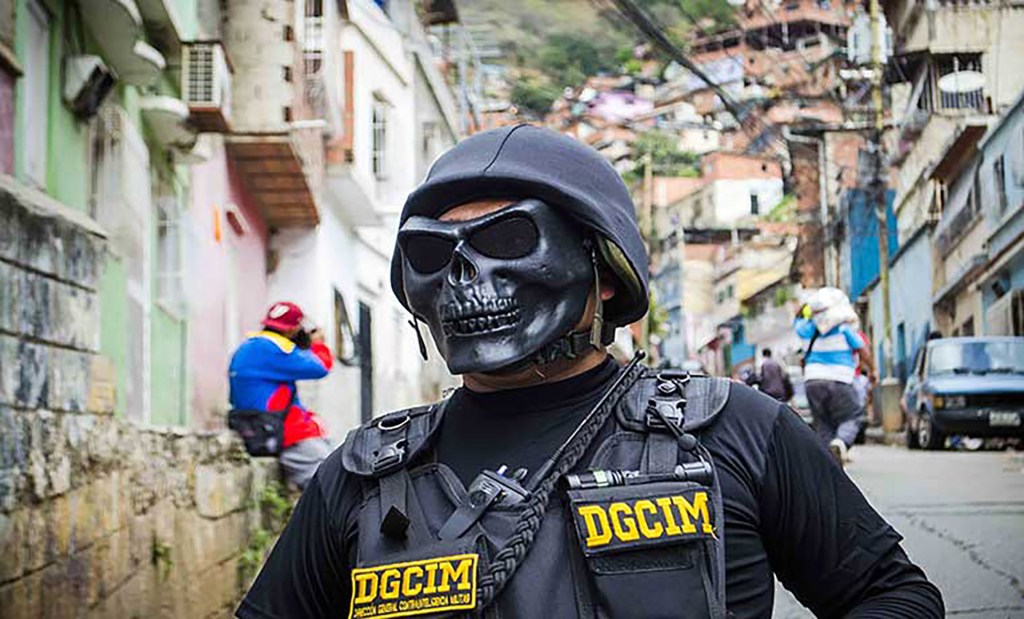
By Alberto Zambrano
Three days after Venezuela’s bloody coup d’etat, and the Davos Forum, on a day like today, Europe signed a treaty full of scorn and deception that would result in today’s political dispensation.
Venezuela’s next-to-last appearance at the World Economic Forum in 1992 -for the following 28 years, no Venezuelan president would attend- had a clear motive, the South American nation was the fastest developing nation in the world thanks to a package of drastic economic policy reforms under the tutelage of the International Monetary Fund & the World Bank, at the request of Venezuela’s government. Europe’s political & financial elites wanted to get some information from the man in charge of jump-starting Venezuela’s economy. It was the beginning of a European adventure of derision and stealth that would rouse the most ardent populism -Brexit.-
Contrary to what some academics -mostly Castro Leiva’s disciples- think hold themselves in very high regard. Venezuelans might not think when facing themselves in the mirror of their vanities, with intelligence merits and capacity of creation or grandiose destiny.
Without a doubt, Venezuelans convincingly believe that under “God & Federation” they’re born with the divine right to be wealthier than everybody else: Pearls, gold, diamonds, iron, aluminum, uranium, coltan, & more oil than any other nation on the planet.Venezuelans tend to think that it is perfectly tolerable that informality, splurge, error & social welfare dictate the course of the South American nation. In the 1990s, TV network RCTV -closed by Hugo Chavez- played a soap opera which heavily satirizes Venezuela’s primary societal ailment: Corruption — written by Ibsen Martínez, “On these streets” narrates the life of several sectors of Venezuela’s society. Eudomar Santos was a character played by actor Franklin Virgüez -a street hoodlum whose main trait was improvisation to move forward in life.- While improvisation in the arts can be a successful strategy, -ask Larry David- in politics, it’s the society that pays the toll for such adventurous endeavors.
Venezuela currently acts as a 21st century El Dorado of modernity: Hellbent & impervious to any logical analysis; a society that has insurmountable amounts of mineral resources undeer their soles, rife with all sorts of mechanism for the coollective & individual advancement.
This Gold Rush Casablanca-Esque mining colony of modern times has no filters nor protocols, let alone boundaries for personal advancement: A Military Academy -The Home of the Blue Dreams- that graduates a soldier who roused in arms with Defence Minister Fernando Ochoa Antich bankers who end up in multi billion dollar scheme frauds of international implication is a clear example.
A conspiracy, formed many years before 1992, -documented with military intelligence dossiers, compiled over time by top-level officers of the Venezuelan Armed Forces,- to overthrow Carlos Andrés Pérez -by murdering him & kidnapping his family- takes place with the necessary cooperation of key players in the -then civilian- political playfield of Venezuela’s power.
With a rather sordid cast of characters, General Fernando Ochoa Antich, a man whose rise to the Ministry of Defense is signed by how Venezuela’s -then-new- democratic political leadership of the early sixties in the Presidencies of Betancourt & Leoni chose to bargain quotas of power with the Military by yearly rotations of Military Academy promotions leads a years-long -and both ideological & fraternally driven- conspiracy.
In the years of the Acción Democrática-led Revolution of 1945, a group of generals with ideological leanings towards the Military governments of the early 1900s went into forceful exile as a purge from Venezuela’s Armed Forces takes place, amongst these officials, a Major by the surname Ochoa -Ochoa Antich’s father, for treason, like life in the barracks is a family thing- goes out of the country and with that group of ex-pats, begin plotting with Soviet spies a military junta power grab.
Carlos Andrés Pérez dismissed the reports repeatedly presented to him as “barrack gossip,” the gravity of this mistake would haunt the Caudillo from the frigid Andean highlands -from which Major Ochoa also hails -after his impeachment in 1993 and the rise of chavismo in 1998.
In the years of the Acción Democrática-led Revolution of 1945, a group of generals with ideological leanings towards the Military governments of the early 1900s went into forceful exile as a purge from Venezuela’s Armed Forces takes place, amongst these officials, a Major by the surname Ochoa -Ochoa Antich’s father, for treason, like life in the barracks is a family thing- goes out of the country and with that group of ex-pats, begin plotting with Soviet spies a military junta power grab.
Carlos Andrés Pérez dismissed the reports repeatedly presented to him as “barrack gossip,” the gravity of this mistake would haunt the Caudillo from the frigid Andean highlands -from which Major Ochoa also hails and Pérez personally, -after his impeachment in 1993 and the rise of chavismo in 1998.
Since the days of Carlos Andrés Pérez first government, “Saudi Venezuela” -UN-ECLAC Keynesian derision,- the country has always encouraged social climbing: The Grand Marshall of Ayacucho Antonio José de Sucre Scholarship program was internal & permanent social ladder -ask Jorge Alberto Arreaza Montserrat.-
The governmental structure created by Venezuela’s politicians in the middle of the 20th century created a government-sponsored social-climbing ladder that paves the way for a civil political elite, -ideologically married to left-of-center Cold War politics.- Baby boomers that want to relive their days of thunder tend to forget -mainly due to neuronal plasticity- that is naïve to think that Venezuelan democracy doesn’t imply traversing the different circles of a Dantean Inferno -of the Bolivarian kind.-
These circles of Chavista Venezuelan Underworld share a lot in common with the straperlo and social-climbing ladders built by none others than the Fathers of Venezuelan democracy. The political groups surrounding the installation of a new democratic regime were at odds with each other for the massive rent benefits resulting from Venezuela’s much profitable mining activity and juicy government contracts.
Venezuela’s area size is more significant than the state of Texas: 925.026 square kilometres of a disturbingly perfect tropical paradise which has seen characters of the likes of Orlando Castro Llanes, Jesús María Castro León, Gustavo Machado, Hugo Chávez, Fernando Ochoa Antich, José Vicente Rangel, Walid Makled, Carlos Andrés Pérez, Alejandro Andrade & Juan Guaidó.
-
Subscribe
Subscribed
Already have a WordPress.com account? Log in now.
 Hispanic politics